Travel eSIM APIs allow travel agencies, online travel agencies (OTAs), resellers and software developers to offer mobile data plans within their own websites, apps and booking platforms.
Choosing a provider depends on several factors: commercial terms, developer access, payment processing, branding flexibility, customer support and integration requirements.
This guide compares six eSIM API providers to help businesses identify the platform that best fits their technical and commercial requirements.
Which travel eSIM API is best for your business?
Travel eSIM API comparison
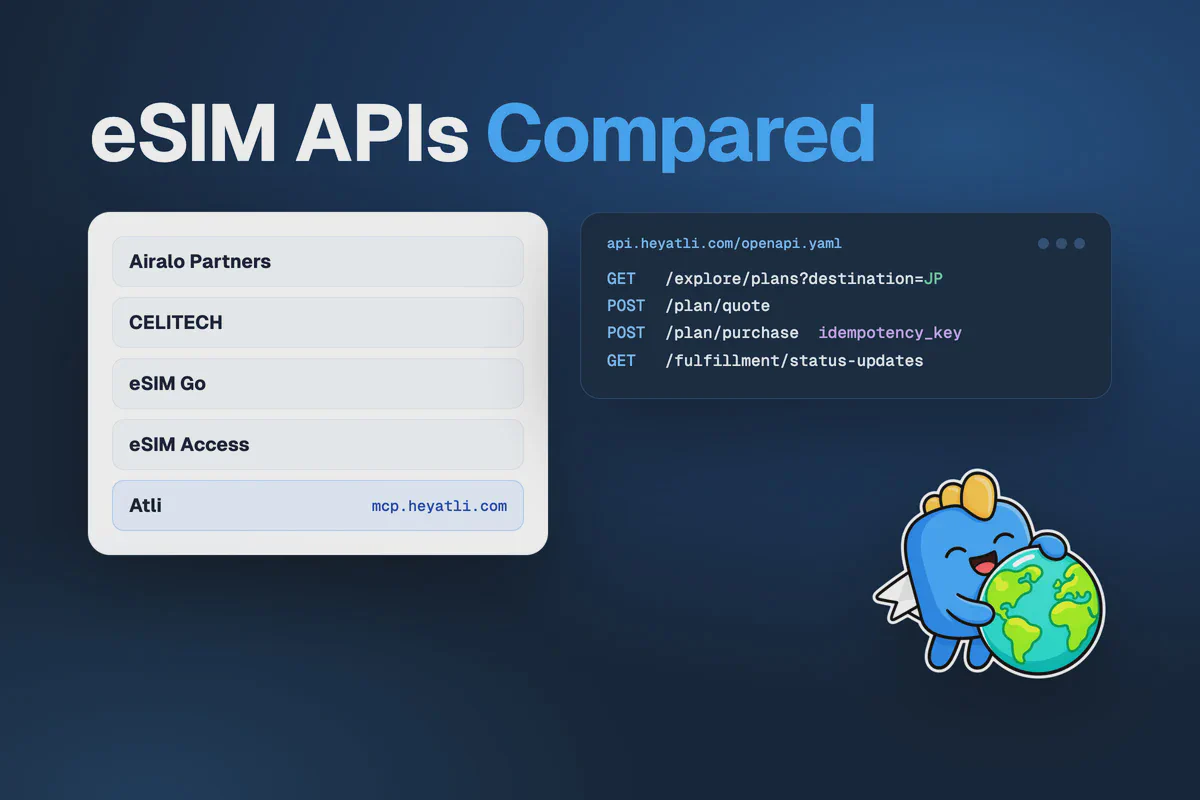
The following comparison covers commercial models, developer onboarding, white-label capabilities, payment infrastructure and AI integration.
| Provider | Primary commercial model | Onboarding and testing | White-label and checkout options | AI and MCP integration | Best fit |
|---|---|---|---|---|---|
| Airalo Partners | Net wholesale pricing (reseller sets retail markup) or affiliate | Partner portal, documented sandbox, OpenAPI and webhooks | Partner API, SDKs, WooCommerce plugin, co-branded or white-label flows | REST API | Travel sites, WooCommerce stores and teams wanting Airalo’s consumer brand |
| CELITECH | Backend margin or revenue sharing | Developer sandbox with SDKs for seven programming languages and documentation | REST API, SDKs, embeddable iFrame (Beta) and partner dashboard | REST API, SDKs and MCP (Beta) | Airlines, OTAs and booking platforms embedding travel connectivity |
| eSIM Go | Prepaid balance with tiered discounts tied to monthly volume commitments | Self-serve portal and rate-limited REST API-key sandbox | Headless API, white-label storefronts and custom MVNO stacks | REST API and webhooks | High-volume resellers, telecom brands and custom white-label apps |
| eSIM Access | Prepaid wholesale wallet for volume resellers | Production API testing with funded account (no dedicated sandbox); ICCID and APN lifecycle webhooks | Headless API-first integration (partner builds storefront UI) | REST API and official MCP server | Resellers building their own eSIM platforms |
| Gigs | Enterprise telecom-as-a-service (custom commercial terms) | Sales-led onboarding and enterprise telecom API | Hosted white-label checkout, subscriptions, voice, SMS and mobile data | REST API | Neobanks, fintechs and consumer apps launching full mobile plans |
| Atli | Commission up to 20% (ongoing account attribution) or approved prepaid Credits resale | Public OpenAPI specification and sandbox (api-staging.heyatli.com); sign in at partners.heyatli.com | Single-tag embeddable widget, REST API with hosted Stripe checkout (brand=none), ?bare install page or custom UI | Live hosted MCP server (mcp.heyatli.com/r/YOUR_CODE) with OAuth | Travel agencies, OTAs, developers and AI-powered travel platforms and assistants |
How do the leading eSIM API providers differ?
Airalo Partners: consumer recognition and WooCommerce integration
Airalo Partners operates on net wholesale pricing, allowing businesses to purchase travel eSIM packages at net rates and set their own retail prices, alongside an affiliate option. Through the Airalo Partners portal, businesses can access a documented developer sandbox, OpenAPI documentation, webhooks, software development kits (SDKs) and the official Airalo WooCommerce plugin. Integration is available through the Partner API in co-branded or white-label flows.
Best suited for: Travel websites, WooCommerce stores and businesses that value Airalo’s consumer brand recognition or require an official WooCommerce plugin.
Limitations: On certain underlying carrier profiles, end users may still see Airalo’s Service Provider Name (SPN). Higher API volume tiers typically require a structured partner review.
CELITECH: connectivity integration for airlines and OTAs
CELITECH focuses on travel distribution platforms such as airlines, OTAs and booking engines rather than operating a competing consumer retail storefront. It offers backend margin or revenue-sharing commercial models. Developer resources include a dedicated sandbox, a REST API, SDKs for seven programming languages, an embeddable iFrame (Beta), a partner dashboard and MCP (Beta) integration for AI workflows.
Best suited for: Airlines, OTAs and booking platforms embedding connectivity directly into native travel booking flows.
Limitations: Commercial terms and custom airline or OTA workflows run through commercial scoping rather than immediate anonymous checkout testing.
eSIM Go and eSIM Access: wholesale distribution and reseller control
eSIM Go and eSIM Access are designed for resellers, telecom brands and mobile virtual network operator (MVNO) platforms running their own consumer eSIM brands at scale. Both use prepaid wholesale balances and expose granular Integrated Circuit Card Identifier (ICCID), Access Point Name (APN), bundle and webhook controls.
- eSIM Go provides a self-serve portal and rate-limited REST API-key sandbox with tiered discounts tied to monthly top-up commitments, detailed in the eSIM Go developer documentation. Integration options include a headless API, white-label storefronts and custom MVNO stacks.
- eSIM Access operates a prepaid wholesale wallet with ICCID and APN lifecycle webhooks and an official MCP server (
@esimaccess/mcp-server), documented in the eSIM Access API documentation. Its headless, API-first architecture requires partners to build and host their own storefront interface. Rather than maintaining a separate sandbox environment, eSIM Access uses its production API for developer testing with funded accounts, subject to its documented testing and order-management procedures.
Best suited for: Resellers, telecom brands and high-volume operators building proprietary eSIM storefronts with full lifecycle control.
Limitations: Under these prepaid wholesale models, the reseller takes responsibility for payment collection, Stripe or payment service provider (PSP) fees, fraud prevention, chargebacks, VAT and tax compliance and frontline customer support for activation or connectivity issues.
Gigs: voice, SMS and recurring telecom subscriptions
Conventional travel eSIM APIs, including Atli, Airalo Partners, CELITECH, eSIM Go and eSIM Access, focus primarily on prepaid data-only travel packages. Gigs operates in a separate category: enterprise telecom-as-a-service (TaaS). Through its REST API and hosted white-label checkout, documented in the Gigs developer documentation, Gigs supports domestic phone numbers, monthly recurring mobile subscriptions, voice calls, SMS and mobile data.
Best suited for: Neobanks, fintechs, global HR platforms, consumer apps and hardware products launching full consumer telecom subscriptions.
Limitations: Onboarding is sales-led with custom enterprise commercial terms, reflecting a broader telecom product than prepaid travel data APIs.
Atli: public sandbox, hosted checkout and MCP integration
Atli provides data-only travel eSIM distribution through a REST API, a single-tag embeddable widget and a hosted MCP server. Businesses can choose between commission-based distribution and approved prepaid Atli Credits resale depending on their payment, invoicing and branding requirements.
Public developer access and sandbox testing: Atli’s OpenAPI specification and sandbox (api-staging.heyatli.com) are publicly accessible. Signing in at partners.heyatli.com provisions a partner account with a partner code, widget configurator, API keys and sandbox access. For customer-paid flows, an application can create a guest account per end user (device_id) to test catalogue lookups, live quotes, hosted Stripe checkout and fulfilment polling without waiting for enterprise approval.
Commission-based distribution and provider-managed payments: Under the commission model, partners earn up to 20% of eligible net sales with ongoing account attribution on later eligible purchases. Atli collects payment through its Stripe account, appears on the customer’s card statement and manages traveller eSIM support and refunds. Teams can launch with the single-tag embeddable widget or build custom plan screens with the Atli eSIM API.
Approved prepaid Credits resale and group purchases: Approved partners can fund prepaid Atli Credits to cover 100% of orders using points_to_redeem, set their own retail pricing and invoice customers directly. Partners can also bundle up to 20 group claims in a single purchase using is_gift: true. Approval rules are documented in the eSIM reseller guide.
White-label integration options: On hosted flows, Atli supports partial customization through hosted Stripe checkout with brand=none and minimal installation pages with ?bare, alongside custom partner-built interfaces. Domain and branding boundaries are documented in the white-label branding breakdown.
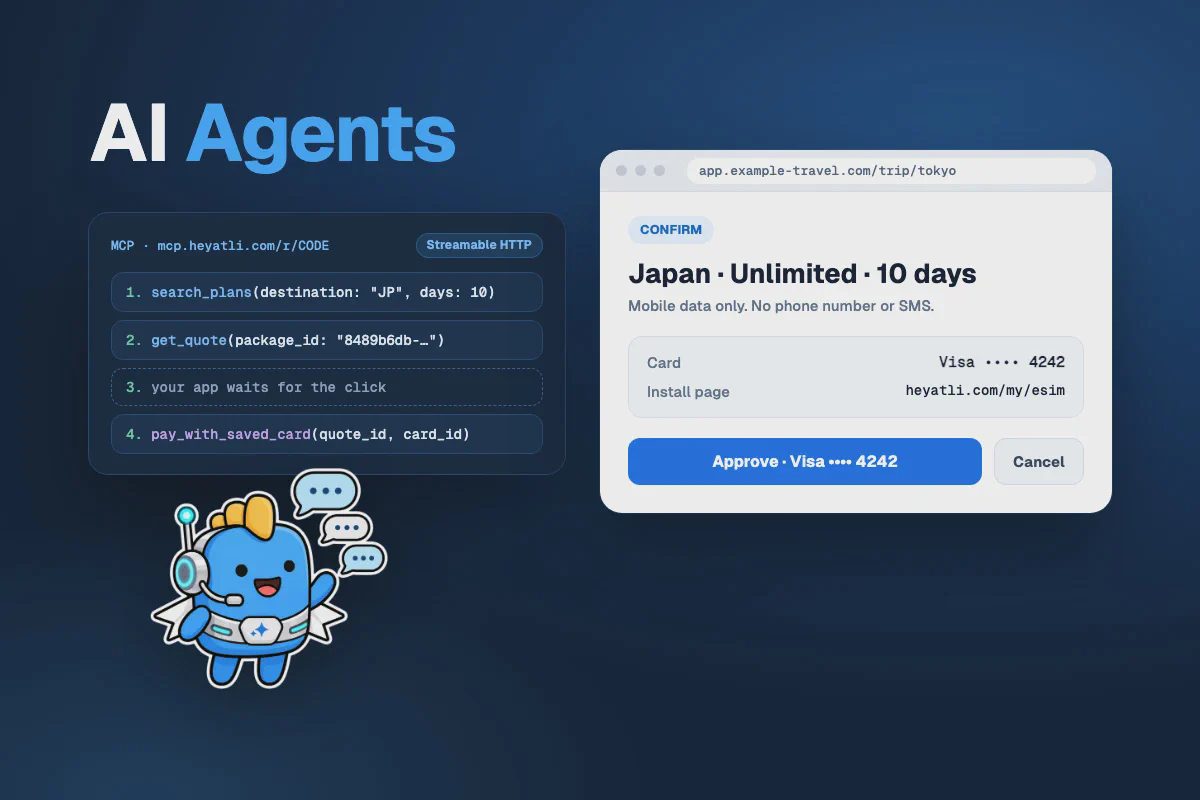
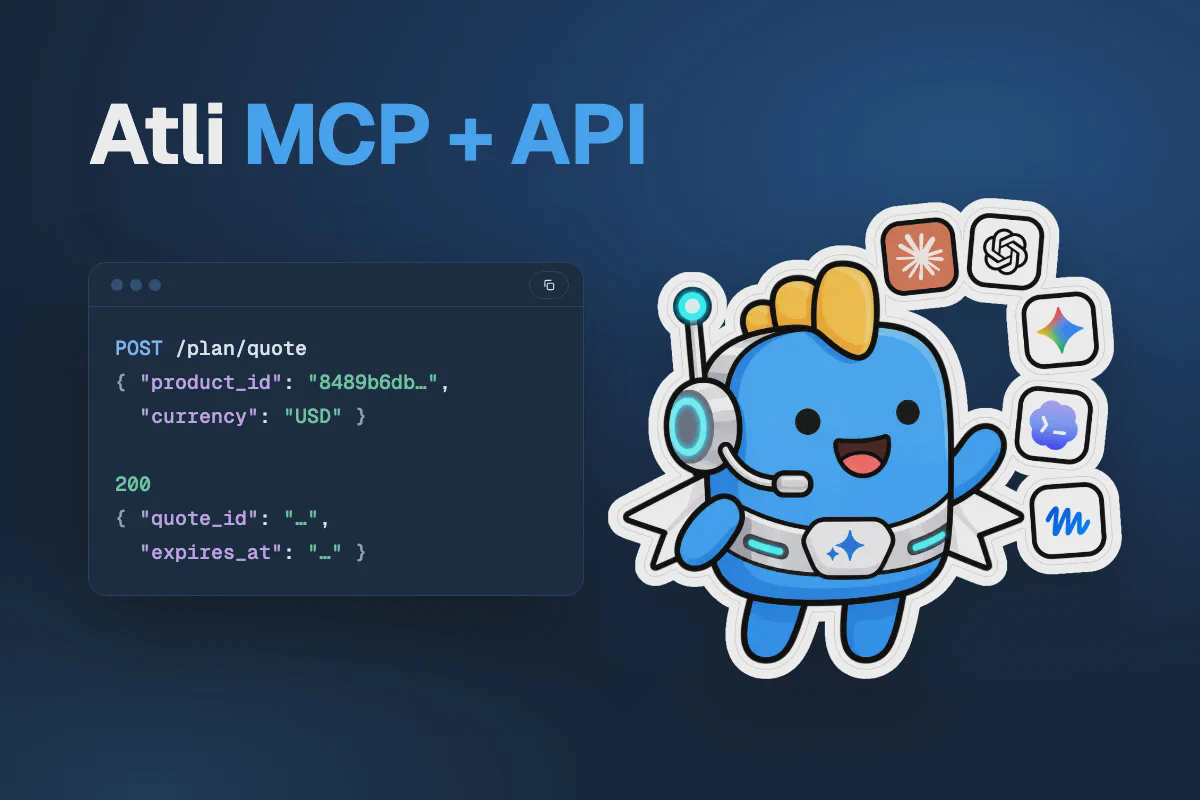
MCP integration for AI assistants: Atli operates a live hosted MCP server (https://mcp.heyatli.com) with OAuth, partner attribution URLs (https://mcp.heyatli.com/r/YOUR_CODE), documentation at partners.heyatli.com/dev/mcp and open tool definitions at github.com/Forgesoft-ai/esim-mcp. Compatible AI assistants, including ChatGPT, Claude, Gemini and custom travel assistants, can search plans, generate quotes and hand off customer checkout inside a conversation with partner attribution.
Best suited for: Travel agencies, OTAs, developers and AI-powered travel platforms that want public sandbox testing, provider-managed checkout or hosted MCP integration.
Commission vs. prepaid wholesale eSIM pricing
Commercial structures differ across providers and partner agreements, particularly around who sets retail prices, collects payments, handles taxes and runs frontline support. The table below compares Atli’s two commercial paths to illustrate the operational split between a commission model and an approved prepaid Credits resale model.
| Operational factor | Atli commission model | Atli approved prepaid Credits resale |
|---|---|---|
| Upfront funding | None required | Funded prepaid Credits balance (requires approval) |
| Retail pricing control | Set by Atli; partner earns up to 20% of eligible net sales | Set by partner; partner bills customers directly |
| Checkout and card processing | Managed by Atli via hosted Stripe checkout | Managed by partner (partner covers own Stripe/PSP fees) |
| Card statement, refunds and support | Atli appears on statement and handles refunds and traveller eSIM support | Partner invoices customers directly and owns customer billing |
| Order settlement | Customer pays Atli directly | Partner covers 100% of order via points_to_redeem |
Third-party wholesale platforms such as eSIM Go, eSIM Access and Airalo Partners (under net wholesale pricing) follow their own partner agreements, where pricing markups, payment processing, chargeback exposure, VAT or tax compliance and frontline customer support responsibilities vary by provider and contract tier.
When Atli may not be the right fit
Atli is not the right match for every integration:
- Voice calls or a local phone number: Atli travel eSIM plans are strictly data-only and do not include phone numbers, cellular voice calls or SMS.
- Pre-built Global Distribution System (GDS) connectors: Atli provides REST APIs, a single-tag embeddable widget and MCP rather than native plugins for Amadeus, Sabre or Travelport.
- Full white-label without building your own UI: Atli’s single-tag embeddable widget retains a mandatory Powered by Atli | Support footer, and hosted payment and installation pages remain on
heyatli.comeven withbrand=noneand?bare. Removing the Atli domain completely requires collecting payment yourself through approved prepaid Credits and rendering the QR code and activation string inside your own interface. See the white-label branding breakdown. - Published wholesale volume rate card on day one: Atli publishes its API and commission structure openly, while prepaid wholesale and volume terms are agreed directly through
[email protected].
How to evaluate a travel eSIM API before integration
Before signing a B2B eSIM agreement, run an identical test order through two or three shortlisted testing environments (dedicated sandboxes, or a funded test account for production-based testing such as eSIM Access) alongside the 10-question travel eSIM API checklist:
- Request a live quote for a primary destination and inspect quote expiry, currency and included local networks.
- Submit a purchase with an
idempotency_key(or quote ID), retry the request intentionally and verify that the account is not billed twice. - Confirm how the API separates
paidpayment status fromcompletedeSIM fulfilment and verify the recovery flow if a paid order stalls. - Test a top-up against an existing ICCID and confirm how quickly the remaining-data endpoint reflects updated usage.
Public developer documentation, sandbox and testing workflows, SDKs and MCP capabilities for Airalo Partners, CELITECH, eSIM Go, eSIM Access, Gigs and Atli checked against official provider portals, documentation sites, public OpenAPI specifications and Atli partner codebases in November 2026. Commercial margins, volume tiers, fees and SLAs vary by partner agreement.
Frequently asked questions
What is a travel eSIM API?
What is the best alternative to Airalo Partners?
Which travel eSIM APIs offer sandbox access?
api-staging.heyatli.com), with partner credentials provisioned upon sign-in at partners.heyatli.com. Airalo Partners, CELITECH and eSIM Go also document dedicated developer sandboxes. eSIM Access does not maintain a separate sandbox environment; developers test directly against its production API using a funded reseller account. Gigs uses sales-led enterprise onboarding.Which travel eSIM API supports Model Context Protocol (MCP)?
https://mcp.heyatli.com) with OAuth, partner attribution URLs (https://mcp.heyatli.com/r/YOUR_CODE), documentation at partners.heyatli.com/dev/mcp and open tool definitions at github.com/Forgesoft-ai/esim-mcp, designed for conversational plan search, quotes and hosted Stripe checkout handoff in AI assistants. CELITECH documents MCP (Beta) for AI workflows, and eSIM Access publishes an official MCP server (@esimaccess/mcp-server, documented at docs.esimaccess.com) authenticated with a reseller API key for developer and agent tooling.Is there a travel eSIM API you can test without an API key?
device_id) alongside a public OpenAPI specification on api-staging.heyatli.com, allowing developers to test catalogue lookups, quotes and hosted checkout flows before provisioning server-side partner API keys.Can businesses sell travel eSIMs without building their own checkout?
What is the difference between commission-based and prepaid wholesale eSIM pricing?
points_to_redeem), the reseller funds a balance upfront to set retail prices and bill customers directly; specific payment fees, chargeback rules, tax compliance and support obligations depend on the provider and partner agreement.