Luang Prabang sits on a narrow peninsula where the Nam Khan river meets the Mekong, a former royal capital of gold-roofed temples and French shophouses that has been UNESCO listed since 1995. The list of things to do in Luang Prabang is genuinely short, and that is not a criticism. This is a town that closes before midnight and asks you to slow down to its speed. The travelers who fight that have a bad time. The ones who give in tend to stay longer than they booked.
Kuang Si Falls, early or late
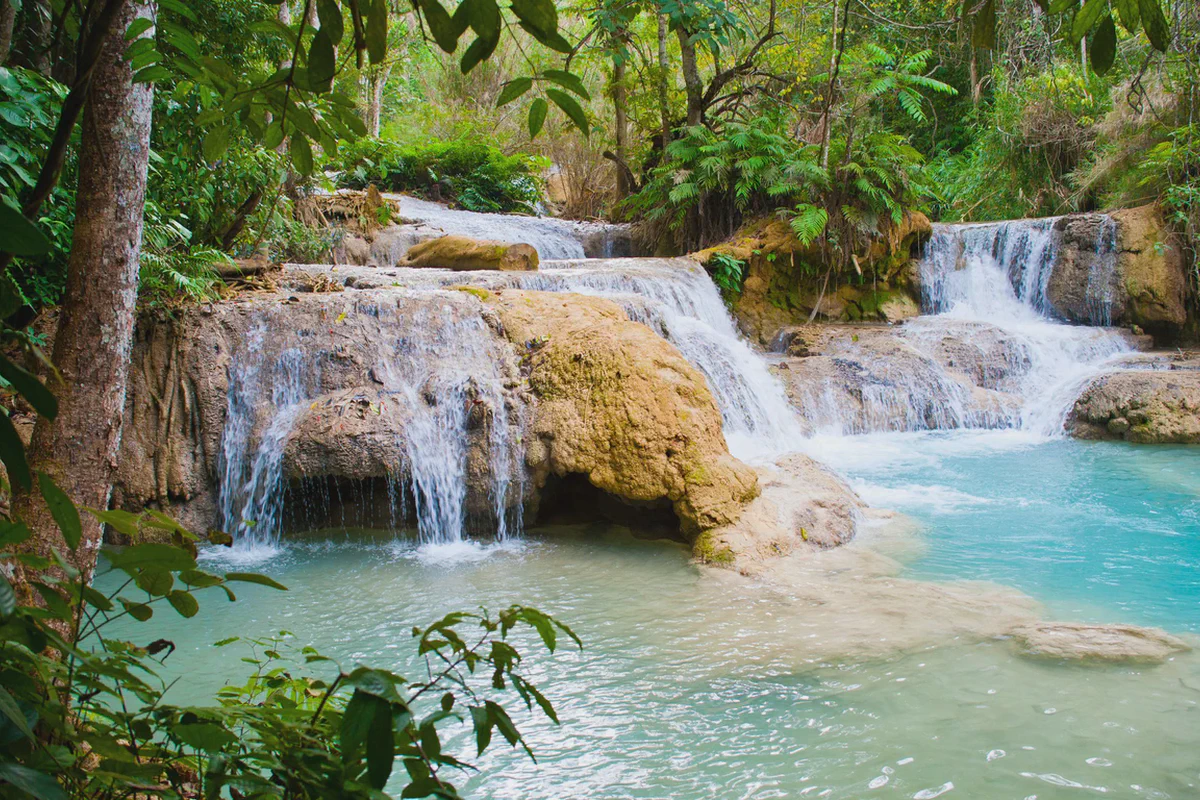
Kuang Si is the reason half the town’s minivans exist: a series of travertine pools stepping down through the forest about 30km southwest of town, an opaque blue-green from the limestone in the water. Entry is 60,000 kip (about US$2.70) and the site is open 8am to 5:30pm daily.
The lower pools are for swimming, with changing sheds nearby. The main fall at the top is taller than photos suggest, and a slick trail climbs beside it if you want the view from above. On the way in you pass the Tat Kuang Si Bear Rescue Centre, home to moon bears saved from the bile trade. It is included in your ticket and worth the ten minutes.
Getting there:
- Shared minivan: sold by every agency on Sisavangvong Road, roughly 70,000 to 100,000 kip return per person depending on the agency. Fixed departure and return times.
- Private tuk-tuk or songthaew: around 250,000 kip return for the vehicle, worth it split between four because you control the schedule.
- Motorbike: the road is paved and scenic, but only if you already ride confidently. This is not the place to learn.
Timing is everything here. Tour groups arrive from about 11am to 2pm and the lower pools turn into a lido. Arrive at 8am or after 3pm and you can have entire pools to yourself. The famous turquoise is a dry-season phenomenon. After heavy rain, roughly July to September, the falls run brown and swollen. Still impressive, not the postcard.

The alms round: watch, don’t perform
Every morning before sunrise, around 5:30am, monks from the town’s monasteries walk in silent single file collecting rice from kneeling residents. Tak bat is a living religious practice, not a show, and Luang Prabang has spent years asking visitors to treat it that way.
How to not be part of the problem:
- Watch from across the street, in silence, dressed with shoulders and knees covered.
- No flash, and no stepping into the procession for a photo. If you would not do it during communion, do not do it here.
- Do not buy rice from the street vendors who materialize around tourists. It is overpriced, often poor quality, and turns an act of devotion into a transaction. Monks have complained about receiving it.
- Only participate if giving alms means something to you, and arrange it through your guesthouse the night before so you do it properly.
The main-street stretch near the Royal Palace draws a scrum of camera phones. Walk two streets back toward the Nam Khan side of the peninsula and you will see the same procession with none of the circus.
The old quarter on foot
The peninsula takes about twenty minutes to walk end to end, which is the correct way to see it.
- Wat Xieng Thong, at the tip of the peninsula, is the town’s finest temple, built in 1560, with a sweeping layered roof and a mosaic tree of life on the rear wall of the main sim. Small entrance fee, paid in cash at the gate.
- The Royal Palace Museum holds the throne room and surprisingly modest living quarters of the last Lao kings, frozen in about 1975 when the monarchy was abolished. Entry around 60,000 kip for foreigners, closed Tuesdays. Dress code enforced, bags and cameras go in lockers.
- Mount Phousi, the hill in the middle of town, charges 30,000 kip for the climb. Everyone goes at sunset, which means a queue for a photo on a crowded ledge. Go at sunrise instead: same view over the two rivers, plus mist, minus the crowd.
Temples here are working monasteries. Novice monks often want to practice English in the late afternoon, and those conversations end up being what people remember.
Things to do in Luang Prabang after dark: the night market
From 5pm to about 10pm, Sisavangvong Road closes to traffic and fills with vendors under red canopies: textiles, indigo-dyed clothing, paper lanterns, silverwork. The refreshing part, if you have arrived from Thailand or Vietnam, is the quiet. Nobody grabs your arm. Bargaining happens in soft voices and small margins. Many pieces are handmade by Hmong and Khmu families, so pay something close to the asking price without guilt.
For dinner, walk the food alleys just off the main strip: grilled Mekong river fish stuffed with lemongrass, Lao sausage, sticky rice, and khao soi, which in Laos is a clear pork-and-tomato noodle soup, nothing like the Chiang Mai coconut version. A full street dinner runs 40,000 to 80,000 kip at mid-2026 prices; add a fruit shake or a whole grilled fish and you can pass 100,000. Finish with a coconut pancake from a griddle cart.

Cross the bamboo bridge
In the dry season, roughly November to May, a bamboo footbridge is rebuilt by hand across the Nam Khan, and washed away again by the monsoon every year. A small toll, paid to the family that builds it, gets you across to Ban Phanluang, where a handful of quiet cafes and weaving workshops look back at the old town. It is a fifteen-minute detour that feels further away than that.
Nightlife, such as it is, means Utopia, a garden bar terraced above the Nam Khan with floor cushions and a volleyball court. Like everything else in town it closes around 11:30pm. After that, the only traditional option is joining the local bowling alley crowd outside town, which is exactly as strange and fun as it sounds.
Learn something: Ock Pop Tok and TAEC
Ock Pop Tok, a textile social enterprise on the Mekong a few kilometres from the centre, runs half-day weaving and natural dye classes, and its riverside cafe is a good afternoon on its own. A free shuttle runs from their shop in the old town. The Traditional Arts and Ethnology Centre (TAEC) is small, well curated, and the best hour of context you can get on the Hmong, Khmu, and other communities whose crafts fill the night market.
Getting there: train or slow boat
The Laos-China Railway changed everything. Vientiane to Luang Prabang now takes about 1 hour 50 minutes, 330,000 kip in second class, about $15, versus ten hours on the old road. Book a day or two ahead through the LCR app or your hotel; trains sell out. The station is well outside town, so budget extra time and a shared shuttle fare for the transfer. Booking through the app needs a connection, which is an argument for arranging data before you arrive rather than after. An Atli plan for Laos connects through ETL, listed with LTE and no 5G; how much you need depends mostly on maps and messaging.
The classic entrance is still the slow boat: two days down the Mekong from Huay Xai on the Thai border, with an overnight stop in Pakbeng. Public boat tickets start around 300,000 kip (about US$14) bought at the pier. It is two full days on a wooden bench watching the river go by, which is either your idea of perfect or a slow torture. Know which one you are before booking. Skip the speedboats regardless; they are loud, cold, and genuinely dangerous.
When to go
- November to January: dry, cool, clear. The best window, and the busiest.
- February to April: burning season. Farmers fire the fields across the region and the air fills with smoke that blurs views and scratches throats. Late March and April are also brutally hot. If air quality matters to you, avoid these months.
- May to October: rain, usually in bursts rather than all day. Everything is green, prices drop, and Kuang Si runs brown.
In the cool season the good guesthouses on the peninsula fill weeks ahead, and location is the thing worth paying for: anywhere in the old quarter puts the market, the wats, and the alms round within a five-minute walk. Compare map pins on Booking.com rather than trusting “city centre” in a listing.
Practical notes: this is a cash economy in a currency that moves fast, so check the kip rate when you arrive and withdraw more than feels natural (ATM fees are charged per transaction). Cards work at better hotels and not many other places. Power cuts happen. None of it will be the thing you remember.
FAQ
How many days do you need in Luang Prabang?
Can you swim at Kuang Si Falls?
Is Luang Prabang walkable?
Should I book the slow boat and the train from my phone?
Checked August 2026.
The Booking.com link above is an affiliate link. Booking through it costs you nothing extra and helps keep Atli running.