Hoi An is a 200-year-old trading port that survived the twentieth century intact and now trades on exactly that. By day it is tailor fittings and yellow walls; by night the lanterns come on and the whole town poses for itself. It is unashamedly commercial and completely charming at the same time, and pretending otherwise ruins the fun. The useful question is which parts repay the money.
The Ancient Town and its ticket
The old town ticket costs 120,000 dong (about $5) and buys a booklet of five coupons, each admitting you to one of the 22 protected buildings: assembly halls, merchant houses, the small museums, the Japanese Covered Bridge. Nobody checks tickets on the street, only at the doors of the heritage buildings themselves, between roughly 8am and 5.30pm. So you can walk, shop and eat ticket-free. Buy one anyway: the Fujian and Cantonese assembly halls and Tan Ky House are the town’s substance, and the money maintains the buildings everyone comes to photograph.
Go before 9am once. At 8am the old town is a town; by 4pm it is a queue.
Getting something made
Hoi An has hundreds of tailor shops, and the spread is wide: linen dresses from about $30, trousers around $70, jackets from $70 to $160, suits from roughly $115 at the mid-range houses up to $200 and beyond at BeBe, and $700 for top-of-the-line cloth at Yaly. The names that come up trip after trip are Yaly, BeBe, Tuong and, for linen, Milan Linen.
The variable that matters is time, not money. Shops will turn a suit around in 24 to 48 hours, but the good result comes from ordering on day one and fitting twice before you leave, which is the real argument for three nights. Bring photos of what you want, be specific about lining and buttons, and remember that a bargain that does not fit is not a bargain.
The lantern boats
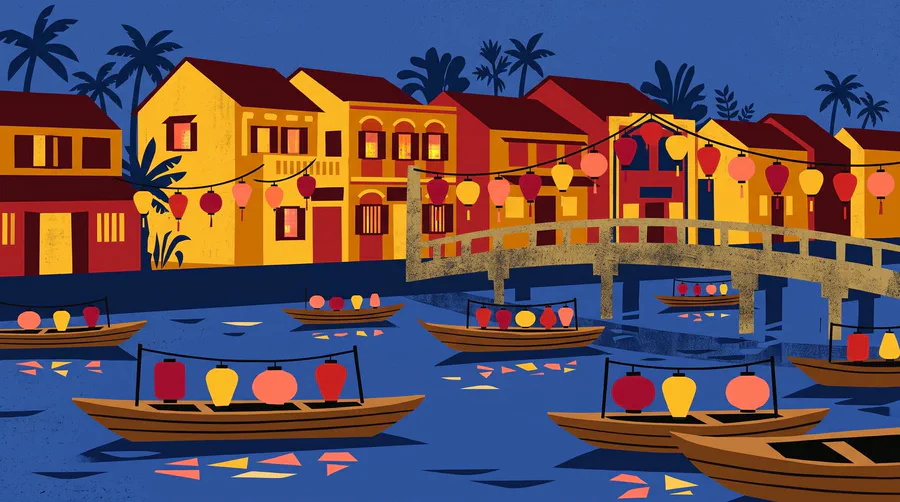
The rowing boats on the Hoai river cost 150,000 to 170,000 dong for one to three people, 200,000 to 220,000 for four or five, per boat, not per person, for about twenty minutes among the reflections. On the fourteenth night of each lunar month, the town’s Lantern Festival, the river is so full of boats you could almost cross it without getting wet, which is either the whole point or your cue to watch from the An Hoi bridge instead. Boats run from late afternoon until about 9.30pm; go at dusk.
An Bang beach
Four kilometres from the old town, straight up Hai Ba Trung street, past rice paddies that make the bicycle the correct choice: 15 to 20 minutes pedalling, or a 60,000 to 80,000 dong Grab. An Bang is a proper beach with loungers, seafood shacks and enough space to swim, and its cafes are where old-town residents go when the lanterns get too much. October to December the sea turns rough; the rest of the year it is the town’s pressure valve.
My Son at sunrise
The Cham temple sanctuary at My Son sits about an hour inland, entry 150,000 dong, open from 6.30am. The red-brick towers, some over a thousand years old and some patched after American bombing left craters that are still visible, are best in the first hour of light, before the heat and the coach groups arrive together. Shared sunrise tours from Hoi An start around $26 including pickup and the entrance fee, which is barely more than doing it yourself and lets you sleep in the van.
Tra Que and the basket boats
Tra Que vegetable village, between town and beach, charges 35,000 dong to wander its herb gardens, watch the farming, and eat things picked in front of you; the fee goes to the village fund, and the whole place is calmer than anything else on this list.
Cam Thanh’s coconut-palm basket boats are the opposite. The ride itself costs 200,000 to 250,000 dong per boat plus a 30,000 eco fee, and the experience comes bundled with floating karaoke speakers, spinning-boat performers who expect tips, and roadside touts selling marked-up tickets to drivers they flag down with claims the road is closed. Some people have a great time. You have been told what kind of time it is.
Eat, then learn to cook it
Cao lau, the pork-and-noodle dish that only claims to be authentic when made with local well water, white rose dumplings, banh mi from the famous stalls, and mi quang from the market: a full street-food day in Hoi An costs less than one tailored shirt. Red Bridge cooking school runs a half-day class with the market tour and a boat ride for $35, or a longer garden version at $59, and combo classes around town start near $20. It is the souvenir that survives the flight home.
Where to stay, and when to come
The real choice is old town edge, for lantern-lit evenings and 8am streets to yourself, versus An Bang, for sea air and quiet nights a short cycle away. Places inside the pedestrian zone mean carrying luggage down car-free streets; check the map pin on Booking.com before deciding how romantic that sounds with a 20-kilo suitcase.
February to April is the sweet spot: dry, warm, not yet furnace-hot. The Thu Bon river floods the low riverfront streets most years between late October and mid-December, sometimes deep enough that boats replace pavements; the town copes with practised calm, but a first-time visit deserves better odds. Hoi An has no airport of its own; you fly to Da Nang, 30 km and about 40 minutes away, from where a Grab runs 250,000 to 350,000 dong. Ordering it beside the luggage belt needs data, which is what a Vietnam eSIM installed at home is for. Where Hoi An fits in a longer route, it is the natural middle stop between the two big cities; the Hanoi vs Ho Chi Minh City guide covers those ends.
FAQ
Do you have to buy the Hoi An old town ticket?
How many days do you need in Hoi An?
Is Hoi An worth it if you hate crowds?
Prices checked September 2026; the old town ticket has held at 120,000 dong since 2017. Tailor prices are examples, not quotes.
The Booking.com link above is an affiliate link. Booking through it costs you nothing extra and helps keep Atli running.