Is Myanmar safe to visit in 2026? For most travelers, no, and the reasons are structural, not headline panic. The country is five years into a civil war. The pagodas are as extraordinary as ever, the people who look after them more so, and neither fact changes the risk math.
What is happening in Myanmar right now
The military seized power in February 2021, jailing the elected government. Resistance to the coup became an armed uprising, and the uprising became a nationwide civil war that has not stopped. In 2026 the military holds the main cities, including Yangon, Mandalay, and the capital Naypyidaw, while ethnic armed organisations and resistance forces control or contest large areas of the borderlands and the interior, by some estimates close to half the country’s territory. Air strikes and drone warfare have escalated rather than wound down.
Two more events shape the current picture. In March 2025 a magnitude 7.7 earthquake on the Sagaing Fault struck near Mandalay, killing more than 3,600 people, destroying over 10,000 buildings, and flattening most homes in the town of Sagaing. Recovery has been slow and uneven, tangled in the conflict. Then the junta staged phased elections around the turn of 2026, votes that Western governments and independent observers widely dismissed as neither free nor fair. The military-aligned government that took office in 2026 changed the letterhead, not the reality on the ground.
What the travel advisories say
This is not a case of one cautious government. As of September 2026:
- United States: Level 4, Do Not Travel, citing armed conflict, civil unrest, arbitrary enforcement of local laws, wrongful detention, landmines, and limited healthcare.
- United Kingdom: the FCDO advises against all travel to Chin, Kachin, Kayah, Kayin, Mon, and Rakhine states, the Sagaing and Magway regions, most of Tanintharyi Region, northern Shan State, northern Mandalay Region, and the part of Bago Region east of the Yangon to Mandalay expressway. It advises against all but essential travel to southern and eastern Shan State, the rest of Mandalay Region, the rest of Bago Region, and seven townships in Ayeyarwady Region.
- Australia, Canada, and EU member states publish equivalent warnings.
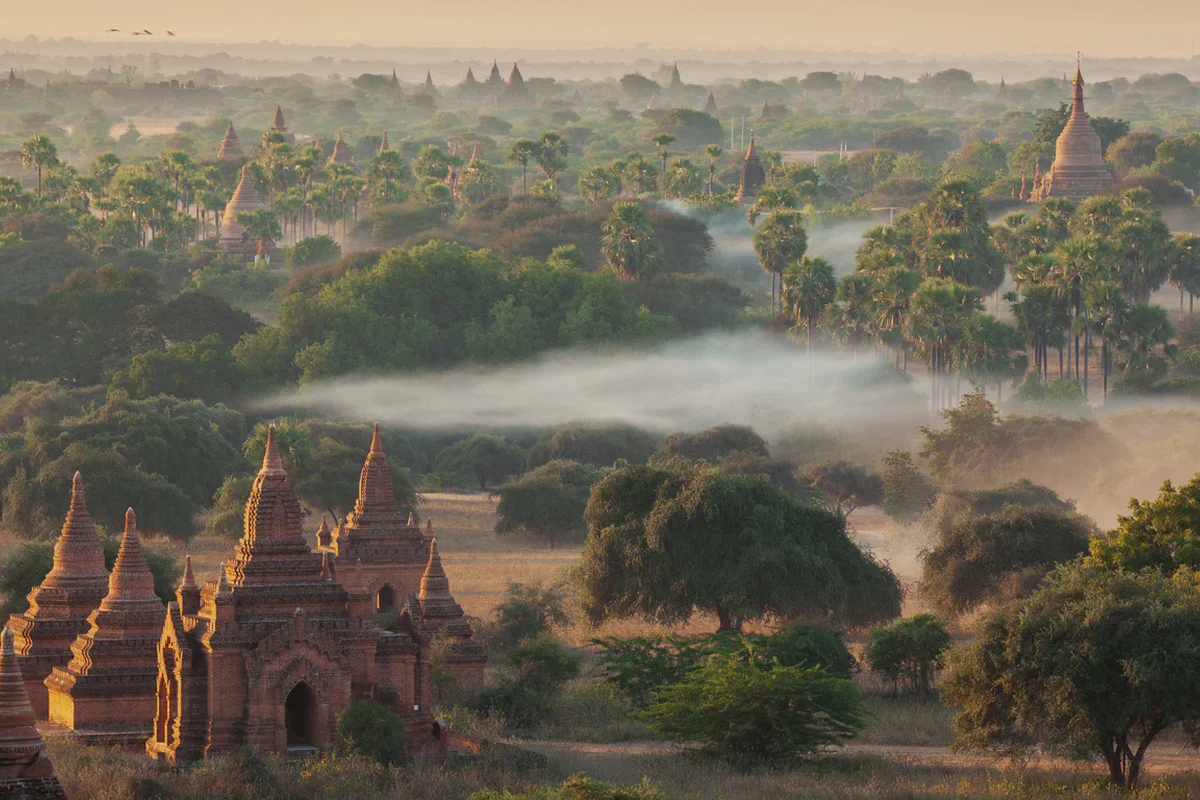
That UK list is the practical map, and it repays a careful reading. It rules out much of the country outright, and its second tier covers three of the four stops on the tourist circuit: Bagan and Mandalay sit in Mandalay Region, Inle Lake in southern Shan State. Yangon is the one major destination currently outside both tiers, which is a statement about relative risk rather than a clean bill.
The advisories carry a cost beyond advice. Most standard travel insurance policies are void in a country your government tells you not to visit. If you go, check the fine print, expect to need a specialist policy, and assume that a medical evacuation, if you can arrange one at all, is coming out of your own pocket. Myanmar’s hospitals were struggling before the war and the earthquake; serious cases have to get to Bangkok.
If you hold both Burmese and foreign citizenship
Myanmar does not recognise dual nationality. The FCDO says it plainly: if you hold it, the authorities may treat you as a Myanmar citizen, and if you are arrested or detained they may refuse consular staff permission to visit or assist you. The second passport is not a shield. In the eyes of the state it may not exist.
Two things follow. The first is conscription. The junta activated the People’s Military Service Law in February 2024 and has been calling up batches since April of that year. It reaches men aged 18 to 35 and women aged 18 to 27, and the US advisory gives the outer limit as 45 for men and 35 for women. The second is that you may not get out. The State Department warns that the regime may stop people it views as eligible for conscription from leaving the country, and names Burmese-born Americans specifically. No consulate can negotiate away an exit ban imposed on someone the state counts as its own citizen.
If you hold Burmese documents, were born in Myanmar, or could be recorded as Burmese through a parent, this is a different decision from the one the rest of this page describes. Take advice from your own foreign ministry before you book anything, and understand where the risk actually sits. It does not end at immigration on arrival. It ends when you are allowed to board a flight out.
So, is Myanmar safe to visit if you stay on the tourist circuit?
Two things are true at once, and any serious answer has to hold both.
The traditional circuit, Yangon, Bagan, Mandalay, and Inle Lake, remains under military control, connected by domestic flights, with hotels open and staff who will be genuinely glad to see you. The junta is actively courting visitors: its own Ministry of Hotels and Tourism has set a target of 1.8 million international arrivals for 2026, about double the number it claims for last year, and e-visas are approved in days. Travelers who have gone recently mostly report calm streets in these zones, no visible combat, and the strange normality that cities under authoritarian control often present.
Here is why that does not add up to “safe”:
- The calm is conditional. Front lines have moved fast throughout this war, including into parts of Mandalay Region already on the UK’s no-go list. A quiet itinerary can stop being quiet with no warning, and internal flight cancellations or road closures can strand you.
- The state itself is a risk. Arbitrary arrest and wrongful detention of foreigners are named in the US advisory for a reason. Political jokes, photos of the wrong building, a social media history, or nothing identifiable at all can attract attention. If you are detained, consular access is limited and slow.
- You cannot fully control your route. Checkpoints, escorts, and permission systems decide where you go. Overland travel between cities passes through or near contested areas, which is why sensible visitors fly, and flying leaves you dependent on a thin domestic schedule.
- Landmines and UXO. Myanmar has recorded some of the highest landmine casualty figures in the world in recent years. This is a rural and border problem rather than a Bagan problem, but it hard-limits any instinct to explore.
- Communications are unreliable. Internet shutdowns, blocked services, VPN restrictions, and power cuts are routine. Assume you cannot count on being reachable, and that your devices may be inspected on entry and at checkpoints.
The ethics are part of the safety question
There is no neutral way to visit. Visa fees, entry tickets, airport taxes, and many hotels feed revenue to a military government at war with much of its own population, and the junta’s visitor targets make clear that tourism is part of its legitimacy project. Myanmar’s exiled opposition and many civil society groups have asked tourists to stay away for exactly this reason.
The counterargument is real too: guides, guesthouse families, drivers, and craftspeople who built lives around tourism have now spent years with almost no income, through a pandemic, a coup, and an earthquake, and money spent carefully with independent, local businesses reaches people who need it. Travelers who go with a conscience book locally owned guesthouses, hire independent guides, pay in ways that skip junta-linked conglomerates where possible, and accept that “where possible” does a lot of work in that sentence.
We are not going to resolve that argument for you. We would only say that if the ethics feel easy in either direction, you have not read enough.
If you go anyway
Some people will go anyway: aid workers already in the country, people with family there, and a small number of determined travelers. If that is you, the risk-reduction playbook looks like this. If you hold Burmese citizenship as well as a foreign passport, the dual-national risks come first, and nothing in this list addresses them.
- Fly in rather than crossing overland. There are no direct flights from Europe or North America, so you will connect through a regional hub, most often Bangkok. The land borders sit in or beside contested territory and the approved crossings are few. The point of flying is to skip that ground, not to save time.
- Get the e-visa before you travel: about US$50 for a 28-day tourist visa, applied for online and typically approved within days. Enter through the approved gateways, currently Yangon, Mandalay, and Nay Pyi Taw international airports plus a limited set of land crossings.
- Stay inside the core circuit and fly between cities. No overland travel near contested regions, no night road travel anywhere.
- Go through a reputable local operator who monitors conditions daily and can re-route you. Independent wandering is how people end up at the wrong checkpoint.
- Carry cash. Crisp, unmarked US dollar bills exchanged as you go; foreign cards often fail and ATMs cannot be relied on.
- Behave as if observed, because you are. No photos of soldiers, police, checkpoints, or government buildings. No political conversation in public, for your sake and, more importantly, for the sake of any local person seen talking to you.
- Carry a phone that is clean, not wiped. Devices can be inspected on entry and at checkpoints, and a blank handset with no photos, no messages, and no history draws attention of its own. The State Department’s instruction is the right one: erase anything on your devices and your social accounts that local authorities could read as political or provocative, and leave an ordinary digital life in place around the gap. Myanmar’s cybersecurity law, enacted in January 2025, penalises setting up or providing VPN services without approval rather than using one, but that is a distinction for a court, not for whoever is holding your phone at a checkpoint. The pre-travel phone checklist covers the mechanics of doing that before you fly.
- Tell your embassy you are there, leave a detailed itinerary with someone at home, and set check-in times.
- Arrange specialist insurance that explicitly covers travel against government advice, and confirm the medical evacuation terms in writing.
None of this makes the trip safe. It makes it survivable if things stay quiet, which is a different standard, and you should notice how far the list above is from anything you would write for Thailand or Laos. If what draws you is golden stupas, river life, and temple plains, Bagan has no substitute, but Laos, Cambodia, and northern Thailand carry some of the same current with none of the war attached. Waiting is also a choice with a moral shape: Myanmar’s tourism families will need visitors badly on the day this ends, and that trip will be a better one in every way.
FAQ
Is Bagan open to tourists in 2026?
Can Americans travel to Myanmar?
Does travel insurance work in Myanmar?
Checked September 2026 against the FCDO and US State Department advisories.