
Your phone needs eSIM support and no carrier lock before it can use Atli. The model name alone is not always enough because Samsung, Pixel, Xiaomi, and other manufacturers sell regional versions with different SIM features. Check the phone itself, then confirm its lock status with the carrier that sold it.
Check for an EID or an Add eSIM menu
You can message Atli in WhatsApp or Telegram to ask about a specific model. Because two phones with the same model name can have different regional hardware, checking for an EID on the device itself is the final confirmation of eSIM hardware.
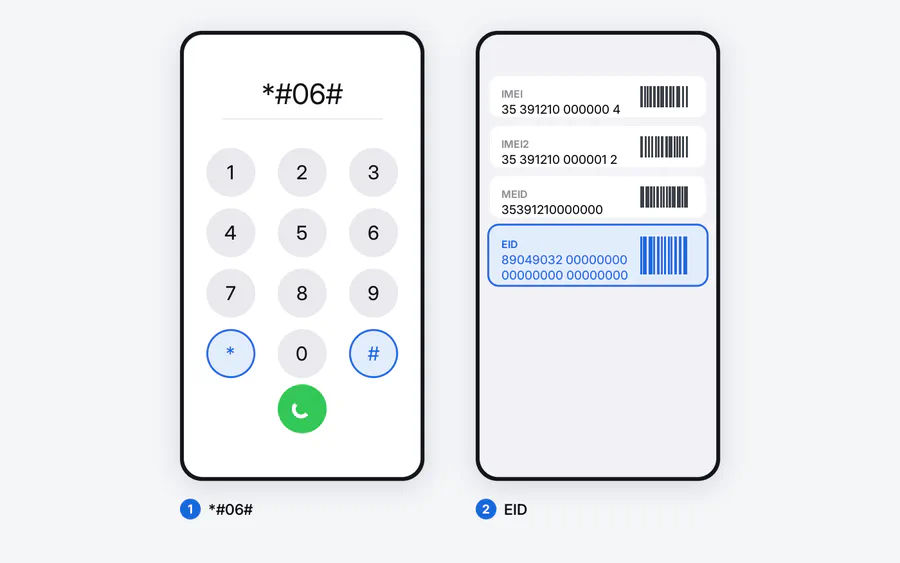
- Open the Phone app and dial
*#06#. Many phones show device identifiers without placing a call. - Look for EID. Its presence is the strongest quick sign that the phone contains eSIM hardware.
- If the code does not show an EID, search Settings for Add eSIM, Set up an eSIM, or Download SIM. Menu names vary by manufacturer and software version.
An EID confirms the hardware, not the carrier lock. If neither the EID nor an eSIM menu appears, check the exact model number on the manufacturer’s support page before buying.
Check whether the phone is carrier-unlocked
An unlocked phone can accept a SIM or eSIM from another provider. This is separate from roaming and separate from eSIM compatibility.
On iPhone
- Open Settings > General > About.
- Scroll down to find Carrier Lock (or Network Provider Lock).
- If it says No SIM restrictions, the iPhone is unlocked. Otherwise, contact the carrier that sold it. Unlock eligibility and fees depend on that carrier’s policy and your contract.
On Android
Android does not provide one reliable lock-status screen across every brand. Searching for other networks does not prove that the phone is unlocked. Ask the carrier that sold the phone, or test a SIM from another provider. If the phone reports that the SIM is unsupported or asks for a network unlock code, it is still locked.
What the manufacturer guidance says
- Apple: iPhone XS, XS Max, XR, and later generally support eSIM. Model and purchase region matter. In China mainland, Apple lists only the iPhone 17e, iPhone Air, iPhone 18 Pro, iPhone 18 Pro Max and iPhone Duo as eSIM-capable. Which iPhones still have a SIM tray depends on where they were bought.
- Google Pixel: Google says Pixel 4 and later support eSIM. Pixel 3 and 3a have carrier and regional exceptions.
- Samsung Galaxy: many Galaxy S, Z, A, XCover, and cellular Tab models support eSIM, but Samsung explicitly says availability varies by country and carrier. Check the model number rather than relying on the family name.
- Other Android brands: Motorola, Xiaomi, OnePlus, Sony, Honor, Oppo, and others sell eSIM models, but support can differ between regional versions. Use the EID and Settings checks above, then verify the exact model on the manufacturer’s site.
For installation after the checks pass, use the iPhone eSIM guide or the Android eSIM guide.
The checks above settle the phone. The network a plan runs on is set by the country instead, and the destination guides list it: Japan, Thailand, Spain.
Checked against current Apple, Google Pixel, and Samsung eSIM guidance, August 2026.