Marrakech is safe in the way a large, busy market town is safe. Violent crime against visitors is rare, the police presence around the medina is heavy and partly in plain clothes, and the US State Department keeps Morocco at Level 2, its second-lowest tier, on terrorism grounds rather than street crime.
What you meet instead is commercial pressure, applied constantly by people who are very good at it. A stranger tells you the square is closed today. Someone takes your wrist and starts drawing on it. A driver explains that his meter is broken. None of that is dangerous. All of it is wearing, and it is far easier to handle the second time you see it, which is the argument for reading it once before you go.
Why you get lost, and who uses that
The medina was founded by the Almoravids between 1070 and 1072 and grew as it needed to. You will read that the alleys were laid out to confuse invaders. They were not. They are simply old, mostly unsigned, and full of dead ends.
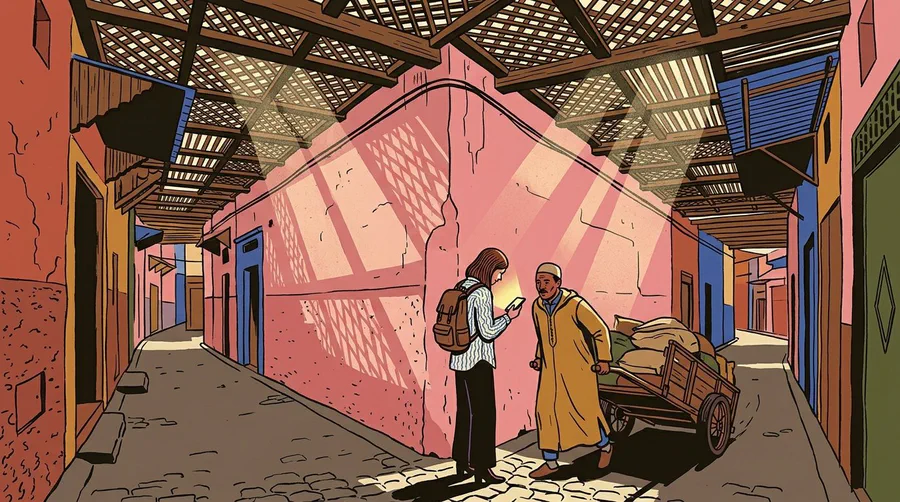
Two things follow from that. You navigate by landmarks rather than street names, so learn the three or four nearest your riad: a mosque, a bakery, the particular archway you turn at. And the covered stretches of the souk cut off enough sky that GPS drifts, which puts the blue dot on the wrong side of a wall just when you need it most.
Looking lost is the trigger for almost everything in the next section. If you need to check the map, step inside a shop and check it there.
Download the Marrakech map area to your phone before you fly so it works with no signal at all. Offline maps cover most of it, and if you want live data as well, a Morocco eSIM connects through Orange Maroc, which is listed with LTE and no 5G.
The approaches you will actually get
| The opener | What is going on | What to do |
|---|---|---|
| “The big square is closed today” | Jemaa el-Fna is a public square and does not close. The walk ends at a shop paying commission | Keep the same pace and keep going. Do not stop to argue the point |
| “The tannery is only open this morning” | A long detour toward Bab Debbagh, a sprig of mint handed over for the smell, then a price for the mint, the guiding and the leather | Decline. The tanneries are open most days and you can walk there yourself |
| The unpaid escort | Someone falls into step beside you for two hundred metres, then presents a bill for the guiding | Do not follow, and do not take the first turn they suggest. Say “la, shukran” once |
| The henna grab | Your wrist is taken and the dye is on before any price is discussed. The price arrives afterwards | Hands in pockets passing the henna stands. If it starts, take your hand back immediately |
| The animal photo | A Barbary macaque or a snake goes on your shoulder while your phone is out | Agree a figure out loud before the camera comes up, or keep the phone in your bag |
What to say
- Do not break stride. Almost every approach depends on you slowing down to be polite.
- Do not debate. A shake of the head and one firm “la, shukran”, or “non, merci”, is the whole exchange.
- If you are genuinely lost, ask a shopkeeper sitting behind a counter, never someone who approached you first. A merchant with a lease has no interest in walking you anywhere.
Jemaa el-Fna after dark
The square works as two different places. By day it is open ground with juice carts and a lot of light. From dusk the food stalls are wheeled in, the Gnawa troupes set up, and it fills.
It is fine to be there at night. Three habits cover most of what goes wrong. Keep your hands in your pockets going past the henna stands, since the pitch there is physical rather than verbal. Agree a price before you photograph anyone’s snake or monkey, and expect to be asked for more afterwards anyway. And in the crowd rings around musicians and acrobats, where people stand shoulder to shoulder and watch upward, move your bag to your front and put your phone in a zipped pocket.
At the juice carts, check the price posted on the stall before you order, and ask whether a takeaway cup costs extra. Prices per glass vary between carts and the takeaway surcharge is where the argument usually starts.
What things cost in the souks
Bargaining here is not a confrontation. It is the normal way a price gets set, often over mint tea, and walking away is a legitimate move rather than an insult.
The opening ask in the tourist souks typically runs two to four times what the item goes for. Counter at around 40 percent of the first number, expect some theatre, and expect to settle near half. If the gap will not close, thank them and leave. You will often be called back.
| Item | Typical opening ask | What buyers report paying |
|---|---|---|
| 🧶 Small Berber rug | 1,500 - 3,000 MAD | 500 - 1,200 MAD, about $54 to $129 |
| 🥿 Leather babouches | 200 - 400 MAD | 80 - 150 MAD, about $9 to $16 |
| 🍲 Tagine pot | 150 - 400 MAD | 50 - 100 MAD plain, 100 - 300 MAD hand-painted |
| 🌿 Argan oil, 250ml culinary | 400 MAD and up | 200 - 300 MAD, about $22 to $32 |
Argan is the one worth being careful about. Oil offered at 40 or 50 dirhams a bottle in the souk is cut with something cheaper, and the theatre of a woman grinding nuts by the door is set dressing. Buy culinary or cosmetic argan at a women’s cooperative or a fixed-price shop, where the price is on the label and nobody negotiates. Dirham figures here convert at roughly 9.3 to the dollar.
Taxis, meters and the airport
Inside the walls you walk, because cars do not fit. Everything below applies to trips between the medina, the new town at Guéliz, and the airport.
Marrakech petits taxis are beige, and they are required by law to run the meter. If a driver will not turn it on, get out and take the next one, which is a thirty-second wait in most of the city. The meter opens at a 7 MAD minimum and most cross-town daytime rides come in between 20 and 40 MAD. From 8pm to 6am a 50 percent night tariff applies, so the same ride is legitimately half as much again after dark. In high summer the night rate sometimes starts an hour later.
From the airport, the ALSA bus 19 runs to Jemaa el-Fna for 30 MAD, roughly every 20 to 30 minutes between 06:00 and 23:30. If you would rather take a taxi, use the official booth at the rank that prints a ticket with the price on it. The fixed fare into town runs about 100 to 150 MAD by day and 150 to 200 MAD between 22:00 and 06:00. Settle it before your bag goes in the boot.
Where you sleep decides how much of this you do at all. A riad inside the walls means walking the last stretch with your luggage, sometimes with a cart sent by the guesthouse, while a hotel in Guéliz means taxis in and out but a door you can drive to, so it is worth comparing the two on Booking.com rather than sorting on price alone.
Numbers worth saving
- Police, in cities:
19 - Ambulance and fire, Protection Civile:
15 - Gendarmerie Royale, rural areas and highways:
177 - From any mobile:
112reaches the emergency services - Tourist police in Marrakech, Brigade Touristique:
+212 524 384 601, based at the edge of Jemaa el-Fna near the Koutoubia
A handful of phrases carry most of the day. “La, shukran” is no, thank you. “Bch-hal hada?” is how much is this. “Le compteur, s’il vous plaît” is the meter, please, and it is usually all a driver needs to hear.
The verdict
Yes, with the caveat that safe and comfortable are different questions. Nothing in Marrakech is likely to hurt you. Plenty of it will try to sell to you, and the first afternoon can feel like being pushed downhill. Walk at your own pace, decide before you go out that you are allowed to say no without explaining, and the city stops being a negotiation and starts being a place to eat and look at things.
FAQ
Is Marrakech safe for solo female travelers?
Is Jemaa el-Fna safe at night?
Do I have to bargain in Marrakech?
Are taxi meters compulsory in Marrakech?
What is the emergency number in Morocco?
Fares, phone numbers and prices checked September 2026 against operator, municipal and government sources.
The Booking.com link above is an affiliate link. Booking through it costs you nothing extra and helps keep Atli running.