Is Brunei worth visiting? Ask this in a Borneo travel group and you will get two camps shouting past each other. One says it is the most boring country in Southeast Asia. The other says it was the surprise of their trip. Both are describing the same place accurately. The difference is how long they stayed and what they expected.
Who actually ends up in Brunei
Almost nobody flies to Brunei for Brunei. You end up there for one of three reasons.
First, you are doing Borneo overland. Brunei sits in the middle of the coastal route between Kota Kinabalu in Sabah and Miri in Sarawak, and skipping it means a long detour anyway. If the country is in your path, spending a night is barely a decision.
Second, Royal Brunei Airlines. RB often prices long-haul fares through Bandar Seri Begawan (London, Melbourne, and various Asian cities) below the direct competition, and a stopover of a day or two costs little to add. People book the fare, then Google what to do with the layover.
Third, you are counting countries. No judgment.
If none of these apply, and you are choosing between Brunei and, say, three more days in Sabah or Sarawak, take the extra Malaysia days. Brunei is a contrast stop, not a headliner.
Getting in and out
The overland buses are the standard way in, and they work.
| Route | Operator | Fare | Time |
|---|---|---|---|
| Miri to Bandar Seri Begawan | PHLS Express | BND 18 (about USD 14) | ~4 hours |
| Kota Kinabalu to Bandar Seri Begawan | Sipitang Express / Jesselton Express | around RM 150 (about USD 35) | 7 to 9 hours |
The Miri bus runs twice daily in each direction (morning and afternoon; from BSB it currently leaves at 7am and 1pm). The KK bus leaves early morning from the city center and involves around four immigration stops, since you exit Sabah, transit Sarawak, and enter Brunei. Operators list this service differently, some daily and some only a few days a week, so check the departure date you want rather than assuming there is a bus every morning. Bring a pen, keep your passport in your hand, and fill in Brunei’s E-Arrival Card online at imm.gov.bn within 72 hours before you cross. Book a day or two ahead on Easybook if you can; the buses are small.
By air, Brunei International Airport is 15 minutes from the center. There is no Grab or Uber in the country. The local ride-hailing app is called Dart, and it works fine in and around the capital; download it before you arrive, because taxis are scarce and public buses stop running around early evening.
Visas are easy for most readers of this site: US, UK, and most EU passports get 90 days free, ASEAN passports enter free, Canada and Japan get 14 days. Everyone still needs the E-Arrival Card.
Day one: Bandar Seri Begawan
The capital is small, quiet, and clean to a degree that feels almost staged. You can walk the entire waterfront core in an afternoon.
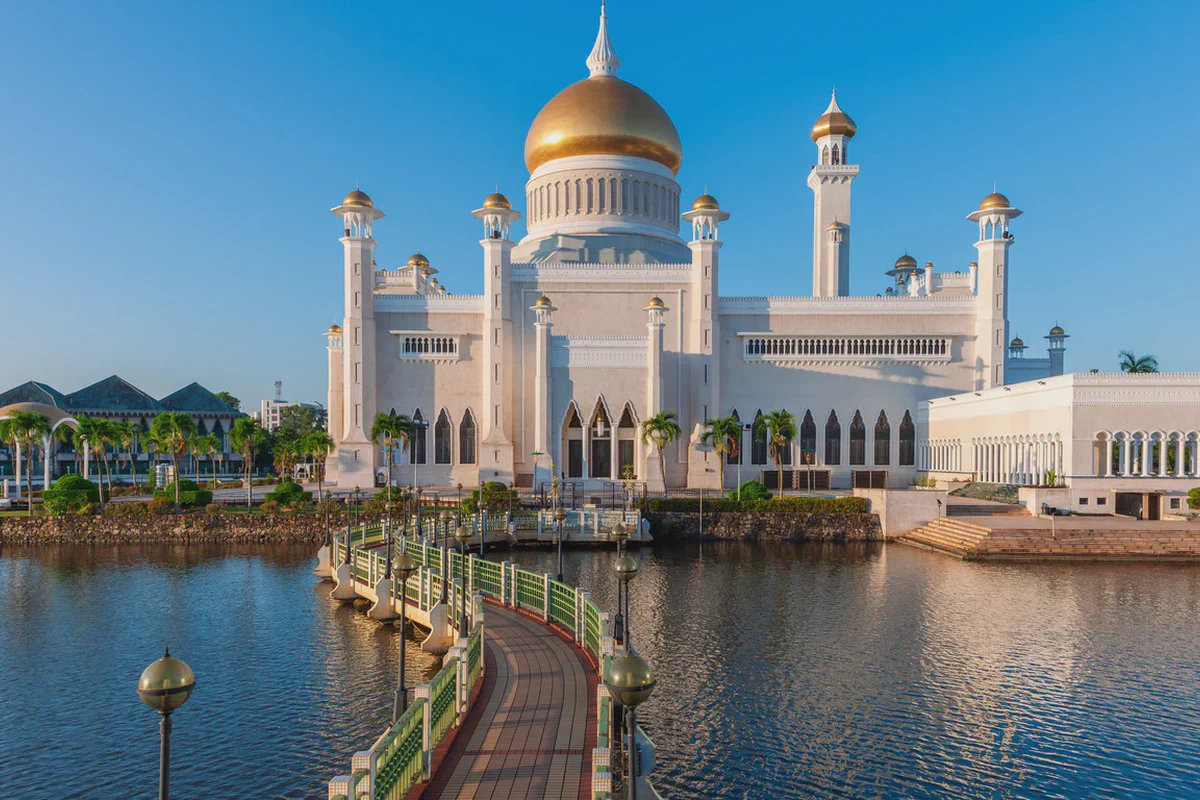
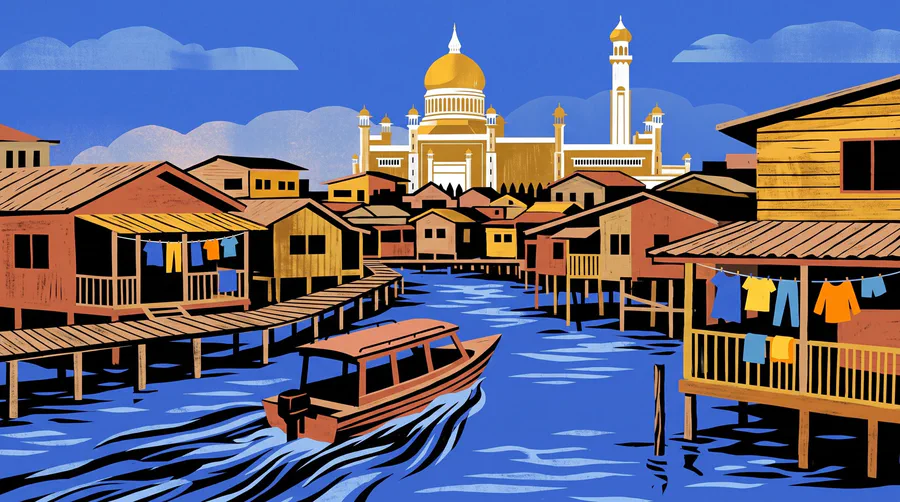
Omar Ali Saifuddien Mosque. The 1958 mosque on the lagoon, with a replica royal barge parked in the water beside it. This is the image on every Brunei postcard and it is better in person, especially at dusk when the marble goes gold. Non-Muslim visitors can go inside Saturday to Wednesday, in set windows (8:30am to noon, 1:30 to 3pm, and 4:30 to 5:30pm); Friday is the late window only, 4:30 to 5:30pm, and Thursday it is closed to tourists. Published hours differ between sources, so confirm locally before you build a Thursday or Friday around it. Dress covered; robes are lent at the door. Free.
Kampong Ayer. A water village of stilt houses across the river, home to several thousand people with schools, mosques, and a fire station all on boardwalks. A water taxi across from the waterfront costs BND 1. Do not stop at the crossing: pay for a proper tour, about BND 20 to 30 for an hour, and the boatman will run you through the village channels and then downriver into the mangroves to look for proboscis monkeys, which you have a decent chance of seeing in the late afternoon. The Kampong Ayer Cultural and Tourism Gallery on the far side is free and gives the history in fifteen minutes.
Jame’ Asr Hassanil Bolkiah Mosque. The bigger, newer mosque out toward Gadong, built for the Sultan’s silver jubilee, 29 golden domes. Worth the short Dart ride if mosques are your thing; skippable if the first one satisfied you.
Gadong Night Market. End the day here. This is where Bruneians actually eat, and it is cheap in a way the rest of the country is not. Grilled chicken skewers and kuih from BND 1, and nasi katok (rice, fried chicken, sambal) for BND 1 to 2. Ten dollars feeds you until you surrender. Stalls get going from about 5pm.
If you want ambuyat, the national dish of sago starch dipped in sour fruit sauce, order it in a proper restaurant rather than at the market. It is texturally strange, mostly flavorless on its own, and you should try it exactly once.

Day two: Ulu Temburong
This is the best thing in the country. Temburong is Brunei’s detached eastern district, mostly untouched rainforest, and since 2020 the 26 km Temburong bridge connects it directly to the capital, so what used to be a boat expedition is now a day trip.
You cannot visit Ulu Temburong National Park independently; access is by licensed tour only. Day tours run around BND 125 to 155 per person with the established operators (Freme is the biggest; Borneo Guide and Sumbiling Eco Village also run trips), including transport, a longboat ride up the Temburong River, lunch, and the main event: an aluminum canopy walkway about 50 meters above the forest floor. The climb up is sweaty scaffolding stairs and the platform sways. The forest view from the top is the payoff, and on a clear morning it is genuinely worth the fee.
Book at least a couple of days ahead, wear shoes that can get wet, and accept that this is the one expensive thing you will do in Brunei.
If BND 150 is out of budget, skip day two entirely and take the bus onward rather than substituting a lesser activity. The city does not hold two full days.
The alcohol ban, and what evenings look like
Brunei is a dry country. No bars, no clubs, no beer with dinner, anywhere, at any price. This is the single biggest factor in whether you will enjoy it, so plan around the facts:
- Non-Muslim visitors aged 17+ may bring in up to 2 bottles (2 liters) of wine or spirits plus 12 cans of beer, once every 48 hours.
- You must declare it at customs on arrival. Undeclared alcohol is a crime, not a shrug.
- What you bring is for private consumption where you are staying. Do not drink in public.
Evenings, then, are markets and food. Gadong on night one. The Kianggeh area and the waterfront for an evening stroll; the mosque lit up after dark; kopitiams and cafes that stay open later than you would guess. By 10pm the capital is effectively asleep. If you have been on the road through Southeast Asia for a while, one quiet, sober, early night is honestly not the worst thing that can happen to you. Two is plenty.
One more cultural note: during Ramadan, eating and drinking in public during daylight is prohibited for everyone, and many restaurants close until sunset. If your dates fall in Ramadan, adjust expectations or adjust dates.
Costs and practicalities
Brunei is not a budget destination, but a short stop does not have to hurt.
- Currency: the Brunei dollar (BND) is pegged 1:1 to the Singapore dollar, and Singapore dollars are accepted at par everywhere. BND 1 is about USD 0.78.
- Sleeping: decent mid-range hotels in BSB run BND 50 to 90. There are only a couple of true backpacker options, so book ahead on Booking.com rather than winging it, and stay near the waterfront so the mosque and Kampong Ayer are on foot.
- Eating: BND 1 to 3 at markets, BND 6 to 15 in restaurants. Food is the cheap part.
- The Empire Brunei: the vast marble resort 20 minutes from town, originally a royal project. You do not need to stay there, but wandering in for a coffee to gawk at the atrium is a legitimate Brunei activity.
- Getting around: Dart for everything. Distances are short and fares are a few dollars.
- Data: an Atli plan for Brunei connects through UNN, listed with LTE and 5G. A short stop is exactly when arranging data in advance pays off, since you are not there long enough to shop around; the eSIM, airport SIM and pocket wifi comparison lays out the trade-offs.
So, is Brunei worth visiting?
Yes, with the frame set correctly. Brunei is not trying to compete with the rest of Borneo, and treating it as a two day cultural intermission between Sabah’s mountains and Sarawak’s caves is exactly the right use of it. The mosques are the best in the region, Kampong Ayer is a real working place rather than a show, the night market is cheap and good, and Ulu Temburong is a proper rainforest day.
What it is not: lively, cheap to sleep in, or a place where things happen after dark. Travelers who arrive expecting a smaller Malaysia leave bored. Travelers who arrive expecting a quiet, orderly, slightly strange oil sultanate with two good days in it leave satisfied, and slightly smug about the BND 1 chicken.
FAQ
How many days do you need in Brunei?
Is Brunei expensive?
Can tourists drink alcohol in Brunei?
Is Brunei safe?
Checked August 2026. Bus fares, tour prices, and mosque visiting hours change; confirm the E-Arrival Card requirement at imm.gov.bn before travel.
The Booking.com link above is an affiliate link. Booking through it costs you nothing extra and helps keep Atli running.