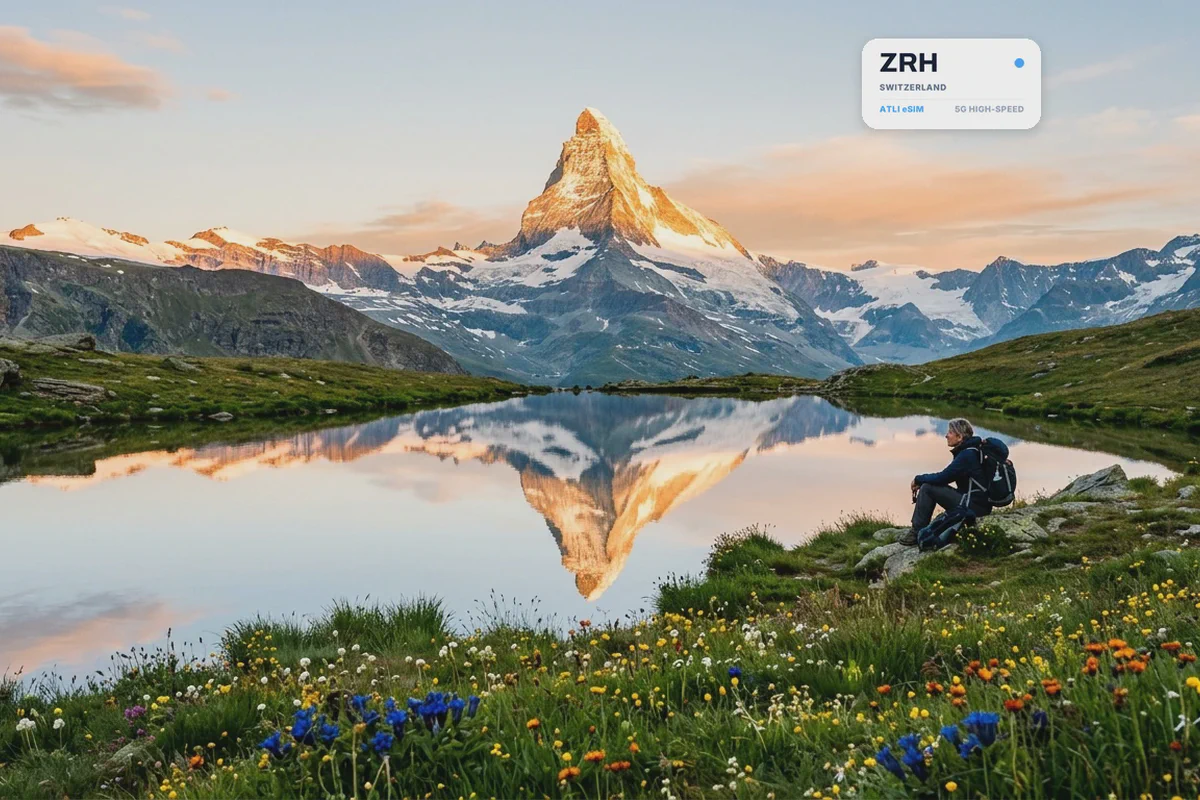
Switzerland sits outside the European Union and the EEA, so an EU roaming allowance from a home carrier may not extend across the Swiss border. That makes a travel eSIM worth comparing with your home plan before relying on SBB trains and other mobile travel tools.
Atli is data-only. It does not provide a Swiss phone number, SMS or cellular voice calls. WhatsApp, Telegram, iMessage, FaceTime, maps and transport apps work through the data connection.
Atli eSIM plans for Switzerland
| Data | Validity | Atli price | Good for |
|---|---|---|---|
| 1 GB | 7 days | $3.99 | A weekend in Zurich or Geneva |
| 3 GB | 30 days | $7.99 | About a week of maps and train lookups |
| 5 GB | 30 days | $10.99 | One to two weeks across several cantons |
| 10 GB | 30 days | $18.99 | Longer trips with regular photo sharing |
| 20 GB | 30 days | $33.99 | Remote work, streaming or frequent hotspot use |
| Unlimited | 5 days | $15.99 | A short trip with heavy data use |
| Unlimited | 30 days | $64.99 | A month without tracking each gigabyte |
These prices were checked in August 2026. Plans and prices can change.
Three gigabytes covers about a week of maps, timetables and messaging. Switzerland pushes usage in a direction that is easy to miss: a lot of the looking up happens outdoors, on a platform or at a trailhead, rather than sitting on a cafe’s WiFi. Choose 5 GB if you upload photos most days, and 20 GB or unlimited if you will tether a laptop.
Compare the two short options before you buy. Unlimited for 5 days is $15.99. The 5 GB plan is $10.99 and runs for 30 days, so unless you know you will burn through five gigabytes in under a week, the cheaper plan also buys you more time.
For a closer estimate, see how much data a trip really uses.
What networks Atli uses in Switzerland
Atli uses two Swiss partner networks: Salt on 2G, 3G, LTE and 5G, and Sunrise on LTE and 5G.
You do not choose between them. Your phone attaches to whichever of the two Atli is granted where you are standing, and it can move between them as you travel. Both list 5G, which means 5G where the device and the local signal allow it rather than everywhere.
The one difference between them is what sits underneath. Salt carries 2G and 3G as fallbacks; Sunrise does not, so on that network LTE is the floor.
Swisscom is Switzerland’s third large operator and is not one of Atli’s partner networks.
Your home plan’s EU roaming may stop at the Swiss border
Switzerland is not in the European Union and not in the EEA. The “roam like at home” rules that let an EU customer use their domestic allowance in another member state do not cover it.
What that means for you depends on your own contract and nothing else. Some European carriers add Switzerland to their standard roaming zone voluntarily. Others leave it out, or put it in a higher-priced tier next to destinations on other continents. The country is named explicitly in the plan’s coverage list either way, so read that list rather than assuming Switzerland is included because it is surrounded by countries that are.
If you are arriving from the UK, the United States, Canada, Australia or most of Asia, none of that applies and your carrier’s ordinary roaming rate does. That is the case a travel eSIM is built for.
Trains, tunnels and mountain valleys
SBB Mobile is the federal railway’s app, with live departures, platform changes and tickets, and most visitors open it more often than anything else on the phone. Load the ticket before you board. The Gotthard Base Tunnel runs 57 km under the Alps, and it is not the only tunnel on a Swiss timetable.
SwitzerlandMobility maps the country’s signposted hiking and cycling routes. MeteoSwiss, the federal weather service, is the forecast people here actually check, because in the mountains it decides whether the walk happens at all.
Coverage above the valley floor is the part no network list can answer. That list says which networks the eSIM attaches to and what those networks carry. It says nothing about terrain, and nobody promises a signal in a side valley, on a cable car or on a pass road in February. Cities, main lines and the lake shores are ordinary coverage areas, and good ones. The uncertainty starts higher up.
Download the route, the ticket and the address before you leave the town you slept in.

If you are choosing a base, compare the exact map pin with the nearest station on Booking.com. Two villages can sit close together on the map and be a long way apart by the one road that joins them.

Keep your normal SIM for your phone number
On a compatible dual-SIM phone, your home SIM and Atli eSIM can have separate jobs: your own number stays on your home SIM for calls and texts, and mobile data in Switzerland comes from your Atli eSIM.
On a dual-SIM phone, set Atli as the cellular-data line and keep your primary SIM active for calls and texts. Turn off data roaming on your primary SIM to avoid unintended roaming data charges. If your carrier supports roaming, verification texts can still arrive on your primary SIM.
Read the dual-SIM travel guide for the settings to check before departure.
Switzerland-only plan or Europe regional plan?
Switzerland is one of the 34 countries on Atli’s Europe regional plan, so this is a real choice rather than a coverage question.
| Plan | Switzerland only | Europe, 34 countries |
|---|---|---|
| 1 GB / 7 days | $3.99 | $4.99 |
| 3 GB / 30 days | $7.99 | $11.99 |
| 5 GB / 30 days | $10.99 | $18.99 |
| 10 GB / 30 days | $18.99 | $32.99 |
| 20 GB / 30 days | $33.99 | $36.99 |
| Unlimited / 5 days | $15.99 | $15.99 |
| Unlimited / 30 days | $64.99 | $70.99 |
On the fixed-data plans the local one is clearly cheaper, and the gap widens as the allowance grows. It is worth seeing what the money actually buys, though. Switzerland’s 10 GB plan and the Europe 5 GB plan are the same $18.99: half the data, thirty-four countries.
On unlimited the two products almost converge. Five days costs $15.99 on either. Seven days costs $19.99 on either. At 10, 15 and 20 days the Europe plan is the cheaper of the two, by $3.00, $2.00 and $1.00 in turn. Only at 30 days does the local plan pull ahead, at $64.99 against $70.99.
Geography makes that easy to act on. Switzerland is small and borders five countries, and every one of them is on the Europe plan: France, Germany, Italy, Austria and Liechtenstein. A day trip to Como, a night in Munich or a flight home out of Milan all stay covered on one plan. That is not true everywhere, which is why the regional plan is a weaker argument on a trip to the United States or Japan and a strong one here.
See the regional eSIM guide if your itinerary crosses several borders.
Travel eSIM or local Swiss SIM?
Switzerland requires identity registration for prepaid SIM cards. Buying one locally means presenting a passport or national ID, either at the counter or through the operator’s own verification process, before the card will work.
Atli is a travel eSIM delivered digitally rather than a Swiss prepaid SIM, so it sits outside that scheme. It also does not give you a Swiss number.
Salt, Sunrise and Swisscom all sell prepaid service directly. Those are local products rather than anything Atli supplies, and their terms and registration steps change, so check the current offer before buying. A local SIM may still suit a long stay, heavy data use or anyone who needs a Swiss number.
For a broader comparison, see eSIM vs airport SIM vs pocket WiFi.
How to set up an Atli eSIM for Switzerland
Install the eSIM at home before you travel, while you still have reliable WiFi. Do not leave it until you arrive: airport WiFi may be slow, require a login or fail at the moment you need it. Check first that your phone supports eSIM and is carrier-unlocked.
Installing the eSIM does not start the plan. The clock starts on whichever comes first: your phone connecting to a network in Switzerland, or 30 days from purchase. So install early without worrying, but buy within 30 days of the trip. More on the timing in what to do before you fly.
After arrival:
- Turn on the Atli eSIM.
- Select Atli as the cellular-data line.
- Turn on data roaming for that line.
- Leave your home SIM off for mobile data if you want to avoid home-carrier roaming charges.
Keep the Atli eSIM installed after the data plan expires. You need only this one eSIM profile: if you buy another plan later, it is added to the same eSIM automatically. There is nothing new to install. Data plans expire; the eSIM itself stays on your phone. Do not delete its profile.
FAQ
Does Atli work in Switzerland?
Can I choose between Salt and Sunrise?
Does my EU roaming allowance work in Switzerland?
Does Atli include a Swiss phone number?
Can I keep my normal phone number?
Does Atli get 5G in Switzerland?
Will I have a signal in the mountains or in a rail tunnel?
Should I buy the Switzerland plan or the Europe plan?
Do I need to register my identity to use Atli?
Can I use my phone as a hotspot?
Can I receive bank verification codes?
Do I need a new eSIM when I buy another plan?
Checked against Atli’s current prices and networks and public Swiss network and rail information, August 2026.
The Booking.com link above is an affiliate link. Booking through it costs you nothing extra and helps keep Atli running.