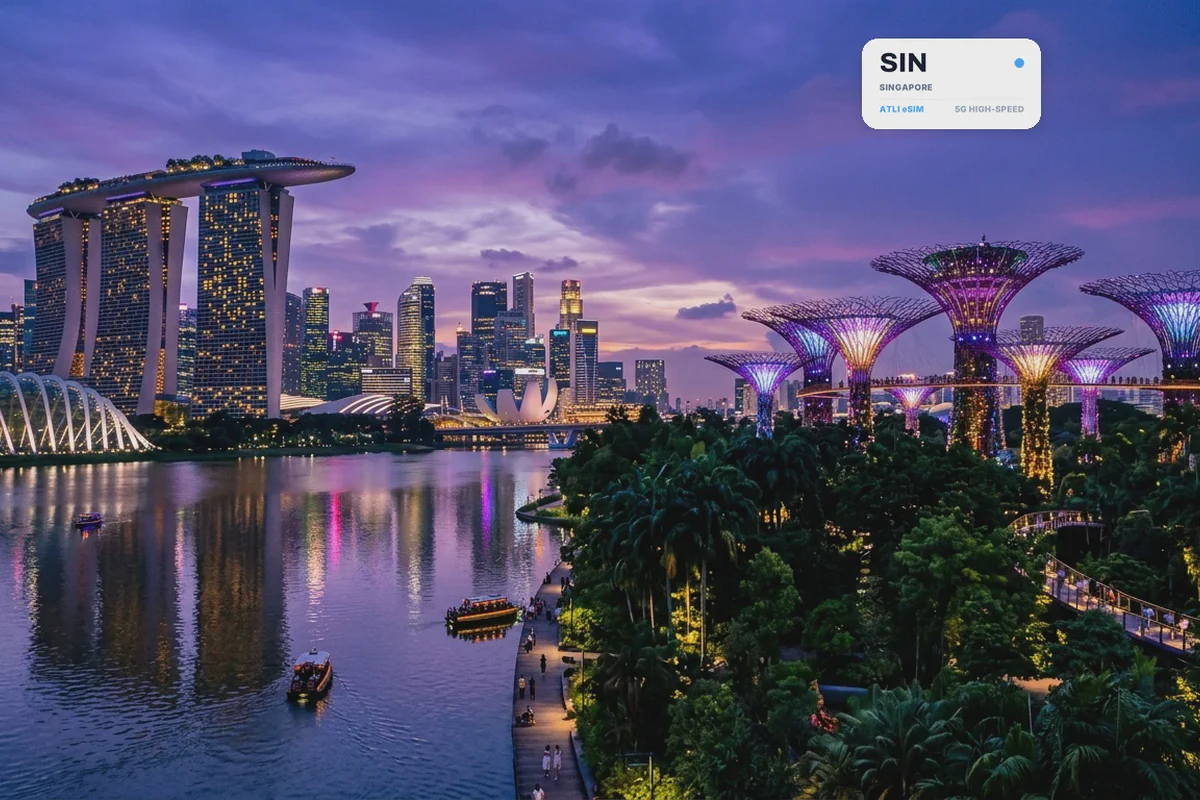
Singapore is compact and transit-friendly, but catching Grab rides, navigating bus interchanges, and looking up reservations still require a live connection. At Changi, the MRT starts the public-transport leg of the trip directly from the airport.
Atli is data-only. It does not provide a Singapore phone number, SMS or cellular voice calls. WhatsApp, Telegram, iMessage, FaceTime, Grab, maps and payment apps work through the data connection.
Atli eSIM plans for Singapore
| Data | Validity | Atli price | Good for |
|---|---|---|---|
| 1 GB | 7 days | $3.99 | A long layover or a two-day stop |
| 3 GB | 30 days | $5.99 | A long weekend of maps and messaging |
| 5 GB | 30 days | $8.99 | A week with regular photo sharing |
| 10 GB | 30 days | $13.99 | Longer stays or some laptop use |
| 20 GB | 30 days | $20.99 | Remote work, streaming or frequent hotspot use |
| Unlimited | 5 days | $14.99 | A short trip with heavy data use |
| Unlimited | 30 days | $64.99 | A month without tracking each gigabyte |
These prices were checked in August 2026. Plans and prices can change.
Singapore sits near the cheap end of Atli’s pricing. Across the 208 countries with a 10 GB monthly plan, the middle of the range is about $47; Singapore is $13.99, against $16.99 for Malaysia next door. That makes the larger sizes easier to justify here than almost anywhere else. If you expect to tether a laptop for a few working days, 10 GB is the size to look at first. See how to hotspot from an eSIM for what tethering does to a plan.
For a closer estimate, see how much data a trip really uses.
What network Atli uses in Singapore
Atli has one Singapore partner network: StarHub on 3G, LTE and 5G.
Singtel and M1 are not Atli partner networks. If you have read that Atli runs on Singtel, that is wrong.
Having a single partner network matters in one specific way. In markets like Germany or the Netherlands Atli has two, so a phone has somewhere else to go when the first is busy. Here there is no second carrier for the eSIM to fall back on.
5G is listed rather than promised for every location. Your phone connects to 5G where the device, the local signal and the plan allow it, with LTE as the normal fallback. Atli’s list describes technologies per network, not geography, so it cannot tell you what the signal does in a particular basement food court or on a specific stretch of tunnel.
Mobile data on the MRT and around the island
Singapore is roughly 50 kilometres across at its widest, and the MRT reaches most of what a visitor comes for. What data buys you is the live version of the journey: which platform, which exit, how many minutes until the next train. Google Maps handles transit directions here well enough that most people never install anything else.
You do not need a stored-value card to ride, and you do not need a signal to get through a gate. Contactless bank cards and phone wallets work at the gantries through SimplyGo, so a card already in your wallet is enough. Transport fares in Singapore are the same either way.
Grab covers both rides and food delivery. It wants a connection at the moment you book rather than a steady one all day, which is a useful distinction when you are deciding how much data to buy.
Two things keep a Singapore trip’s data use below what the day count suggests. Free WiFi is common in malls, hotels and cafes, and the Wireless@SG network adds more of it in public places. Distances are also short, so you spend less time with maps open than you would across a larger country.
Carry some cash for hawker centres. A number of stalls still take notes only, and the QR codes propped on the counters are generally tied to Singapore bank accounts rather than to anything a visitor can sign up for.

If you are choosing where to stay, compare the exact map pin with the nearest MRT station on Booking.com. A room a few minutes from a station on a direct line will usually move you around faster than a Marina Bay address.

Keep your normal SIM for your phone number
On a compatible dual-SIM phone, your home SIM and Atli eSIM can have separate jobs: your own number stays on your home SIM for calls and texts, and mobile data in Singapore comes from your Atli eSIM.
On a dual-SIM phone, set Atli as the cellular-data line and keep your primary SIM active for calls and texts. Turn off data roaming on your primary SIM to avoid unintended roaming data charges. If your carrier supports roaming, verification texts can still arrive on your primary SIM.
Read the dual-SIM travel guide for the settings to check before departure.
Singapore-only plan or Southeast Asia regional plan?
Singapore is where this decision is easiest, because the local plan wins on price at every size:
| Plan | Singapore only | Southeast Asia |
|---|---|---|
| 1 GB / 7 days | $3.99 | $5.99 |
| 3 GB / 30 days | $5.99 | $11.99 |
| 5 GB / 30 days | $8.99 | $15.99 |
| 10 GB / 30 days | $13.99 | $20.99 |
| 20 GB / 30 days | $20.99 | $28.99 |
| Unlimited / 5 days | $14.99 | $22.99 |
| Unlimited / 30 days | $64.99 | $73.99 |
The gap runs from two dollars at the smallest size to nine at the largest. At 3 GB the regional plan costs twice as much. There is no crossover point where the regional plan becomes the cheaper way to get data in Singapore, which is not true of every country in the region: for Malaysia the regional plan is the better buy at 20 GB.
So the regional plan is a coverage decision, not a price one. It covers eight countries: Australia, Indonesia, Malaysia, New Zealand, the Philippines, Singapore, Thailand and Vietnam.
That matters more here than in most places, because Singapore is a stopover as often as it is a destination. A Singapore plan stops working at the causeway to Johor Bahru and on the ferry to Batam or Bintan. If either is on the itinerary, or if Singapore is two nights inside a longer regional trip, pay the difference and buy once.
See the regional eSIM guide if your itinerary crosses several countries.
Travel eSIM or local Singapore SIM?
Singapore requires registration before a locally issued prepaid SIM can be used, and the Infocomm Media Development Authority oversees the rules. Buying a local prepaid SIM therefore means presenting a passport at the point of sale.
Atli is a travel eSIM delivered digitally rather than a Singapore prepaid SIM, so it is not part of that process. It also does not give you a Singapore number.
A local product may still suit a longer stay, heavy data use or anyone who needs a Singapore number. StarHub sells prepaid service directly, as do Singtel and M1. Those are separate local products rather than services supplied by Atli, so check the current offer and what registration involves before buying.
For a broader comparison, see eSIM vs airport SIM vs pocket WiFi.
How to set up an Atli eSIM for Singapore
Install the eSIM at home before you travel, while you still have reliable WiFi. Changi offers free WiFi, but it is something you have to stop and connect to, and it does not cover the taxi queue or the train. Arriving with data already running is the simpler version. Check first that your phone supports eSIM and is carrier-unlocked.
Installing the eSIM does not start the plan. It starts when your phone first connects to a network at the destination. You have up to 30 days after purchase to make that first connection; after that, the plan starts automatically. Buying inside 30 days of departure is the way to avoid losing days, as the pre-flight activation guide explains.
After arrival:
- Turn on the Atli eSIM.
- Select Atli as the cellular-data line.
- Turn on data roaming for that line.
- Leave your home SIM off for mobile data if you want to avoid home-carrier roaming charges.
Keep the Atli eSIM installed after the data plan expires. You need only this one eSIM profile: if you buy another plan later, it is added to the same eSIM automatically. There is nothing new to install. Data plans expire; the eSIM itself stays on your phone. Do not delete its profile.
FAQ
Does Atli work in Singapore?
Does Atli use Singtel?
Does Atli get 5G in Singapore?
Should I buy the Singapore plan or the Southeast Asia one?
Will a Singapore plan work in Malaysia or Batam?
Does Atli include a Singapore phone number?
Can I keep my normal phone number?
Do I need to register with my passport?
Can I use my phone as a hotspot?
Can I receive bank verification codes?
Do I need a new eSIM when I buy another plan?
Checked against Atli’s current prices and networks and official Singapore regulator and operator information, August 2026.
The Booking.com link above is an affiliate link. Booking through it costs you nothing extra and helps keep Atli running.