Angkor is not one temple. It is a park of several dozen ruins spread over an area bigger than Manhattan, and the difference between a great visit and a hot, templed-out slog comes down to a few decisions you make before you arrive. This Angkor Wat first-timer’s guide covers the ones that matter: the ticket, the sunrise question, which circuit to ride, and how to get around.
Which Angkor pass to buy
Three options, all priced in US dollars, which Cambodia uses alongside the riel:
| Pass | Price | Validity |
|---|---|---|
| 1 day | $37 | That day |
| 3 days | $62 | Any 3 days within 10 days |
| 7 days | $72 | Any 7 days within a month |
The 3-day pass is the right call for almost every first-timer. One day at Angkor is genuinely rushed: you would be choosing between the bas-reliefs at Angkor Wat and the tree-swallowed corridors of Ta Prohm by early afternoon, with heat making the decision for you. Three separate day passes would cost $111, so the 3-day pass pays for itself on day two. The days do not need to be consecutive, which means you can put a pool day or the Angkor National Museum in the middle.
Buy from Angkor Enterprise, the official government operator: online at angkorenterprise.gov.kh (screenshot the QR code, since signal at the gates is patchy), at the main ticket office about 4 km from central Siem Reap (open 5am to 5:30pm), or from vending machines at the west entrance and the Heritage Walk mall. Nowhere else. Tickets from agents, hotels, or anyone outside those channels are marked up or fake.
One rule worth knowing: buy your ticket after 4:30pm and it is issued for the following day, but you can enter the park that same evening free, in time for sunset from Phnom Bakheng. That is effectively a bonus half day.
Children under 12 enter free. Bring the child’s passport as proof of age; a photo or copy is often not accepted, and it gets checked at temple entrances.
How sunrise at Angkor Wat actually works
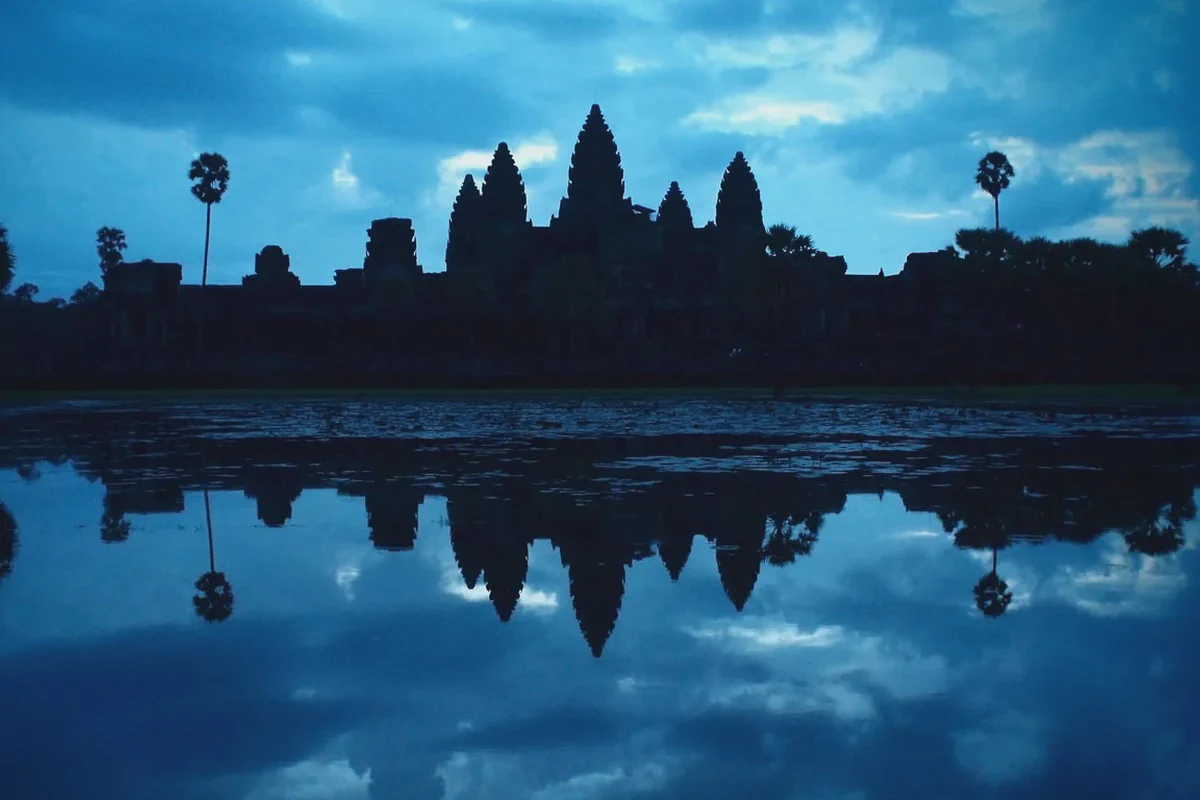
The photo everyone wants is the five towers reflected in the northern pond, sky going orange behind them.
You leave Siem Reap between 4:15 and 4:30am. The temple opens at 5am; you want to be through the gate and at the pond by about 4:45 to stand in the front row, sharing it with somewhere between several hundred and a few thousand people, most holding phones overhead. Sunrise itself falls roughly between 5:30 and 6:30 depending on season, and in the rainy months (May to October) clouds regularly cancel the show entirely.

Do it once anyway, with two adjustments. First, when the sun clears the towers and the crowd turns to leave, go into the temple instead: for the next hour Angkor Wat is emptier than it will be at any other time of day, and the third-level galleries are cool and quiet. Second, if the scrum is not your thing, stand further back on the causeway or skip the pond entirely; the light on the stone is the actual event, and it happens everywhere.
On your other park days, skip sunrise but keep the early start. Being at any major temple by 7am beats any amount of clever routing.
Small circuit vs grand circuit
The temples are strung along two traditional loops, and nearly every driver knows them by name.
The small circuit (about 17 km) is the greatest-hits day: Angkor Wat, the walled city of Angkor Thom with the face towers of the Bayon, the Terrace of the Elephants, and Ta Prohm, where strangler figs have grown through the walls and been left in place. Banteay Kdei usually rounds it out. This is the day with the three sites you came for, and also the day with the crowds.
The grand circuit (26 to 28 km) extends the loop north and east: Preah Khan, a long monastic complex you walk end to end; the island temple of Neak Pean; Ta Som, with a tree-crowned gate; East Mebon and Pre Rup, brick pyramid temples that work well late in the day. Fewer buses, more birdsong, and by this point you can read a doorway lintel without a guide.
Order matters less than people think, but a common plan that works: grand circuit on day one to learn the architecture on quieter ruins, small circuit with sunrise on day two, then day three for whatever grabbed you, or for Banteay Srei, a small pink-sandstone temple with the finest carving in the park, about an hour north by tuk-tuk (agree a higher price for the distance, as it sits outside both circuits).

Tuk-tuk, bike, or car
A tuk-tuk with driver is the default and the right one. Expect $15 to $25 for a full small-circuit day, more for a sunrise start, the grand circuit, or the run to Banteay Srei; agree the price and the pickup time the night before. Your driver waits at each exit, knows where the shade and cold water are, and the open-air ride between temples through the forest is part of the day. Hotels can arrange a reliable driver, and keeping the same one for all three days usually gets you a better rate.
Cycling is doable and cheap: rentals run $2 to $5 a day (the White Bicycles charity rents at $2 through partner guesthouses), the roads in the park are flat and paved, and the small circuit is a reasonable ride if you start at dawn. By 11am, from March to June especially, pedalling between temples stops being fun. The grand circuit by bicycle is for committed riders only.
A car with driver runs $30 to $50 a day, worth it mainly in the rainy season or for the long Banteay Srei run. Guides are separate from drivers; a licensed English-speaking guide adds real depth at the Bayon and Angkor Wat bas-reliefs in particular, and can be booked for a single day rather than your whole visit.

Dress code and temple manners
The rule is shoulders and knees covered, for everyone, and it is checked. Light long trousers or knee-length shorts and a t-shirt solve it; a scarf over a vest top does not always pass.
Enforcement is strictest at the Bakan, the steep upper level of Angkor Wat, where staff refuse entry for vests, short shorts, and short skirts, and the queue closes well before the park does. The climb is worth planning around: go in that first post-sunrise hour, dressed for it.
Beyond clothing: these are working religious sites, so keep voices down inside sanctuaries, do not touch the carvings, and step over, never on, raised thresholds. Hats off inside shrine rooms. Drones are banned without a permit.
The practical bits
Hours: Angkor Wat opens at 5am for sunrise and closes at 6pm; most other temples run 6am to 6:30pm; and the sunset hills, Phnom Bakheng and Pre Rup, stay open to 7pm. Closing times shift slightly with the seasons.
Heat management is the real skill. Carry more water than seems reasonable (drink stalls inside the park charge about $1 a bottle), take the midday break seriously, and treat 7am to 11am and 3pm to 6pm as your working hours. November to February is the kindest season, and also the busiest.
Sleep close. Sunrise days start at 4:15am, so a room in central Siem Reap near the Old Market or along Wat Bo Road keeps the ride short, and a pool stops being a luxury by the second afternoon; both are worth filtering for on Booking.com.
Money: dollars work everywhere, small bills especially; change under a dollar comes back in riel. Expect polite but persistent vendors, and children selling postcards near the exits. Do not buy from children (it keeps them out of school), and skip any tour that includes an “orphanage visit”.
Data: you will be messaging your driver about pickup times and checking closing hours, so sort a connection before you arrive. An Atli plan for Cambodia connects through Metfone, listed with LTE and no 5G. Cambodia also sits inside the Asia and global bundles, so if Angkor is one stop on a longer regional run, a regional eSIM covers it alongside the neighbours.
Finally, pace yourself. Temple fatigue is real, usually arriving mid-afternoon on day two. The visitors who enjoy Angkor most are the ones who see eight ruins properly rather than eighteen at a trot, and who are back at the pool by one.
FAQ
Is one day enough for Angkor Wat?
Can you buy Angkor Wat tickets online?
What should you wear to Angkor Wat?
Is sunrise at Angkor Wat worth it?
Do I need mobile data at Angkor?
Checked August 2026.
The Booking.com link above is an affiliate link. Booking through it costs you nothing extra and helps keep Atli running.